
Introduction
Aapne blog ya website bana li. Articles bhi publish kar diye. Lekin traffic nahi aa raha?
Ye problem almost har beginner face karta hai.
You may write helpful blog posts, optimize your titles, add keywords, and improve your website speed. But still, your website may need time to build trust.
This is where off-page SEO becomes important.
Simple words me samjhein, off-page SEO means the activities that happen outside your website but can help build your website’s trust, authority, and online reputation.
The most common part of off-page SEO is backlinks.
A backlink is a link from another website to your website. When a trusted and relevant website links to your content, it can send a positive trust signal.
But backlinks are not about collecting random links. Quality, relevance, and natural growth matter more than quantity.
In this guide on off-page SEO and backlinks, you will learn what off-page SEO means, how backlinks work, why they matter, safe ways to build backlinks, and common mistakes beginners should avoid.
By the end of this article, you will have a clear understanding ki Off-Page SEO and Backlinks, SEO mein itne important kyun hain.
Table of Contents
What Is Off-Page SEO?
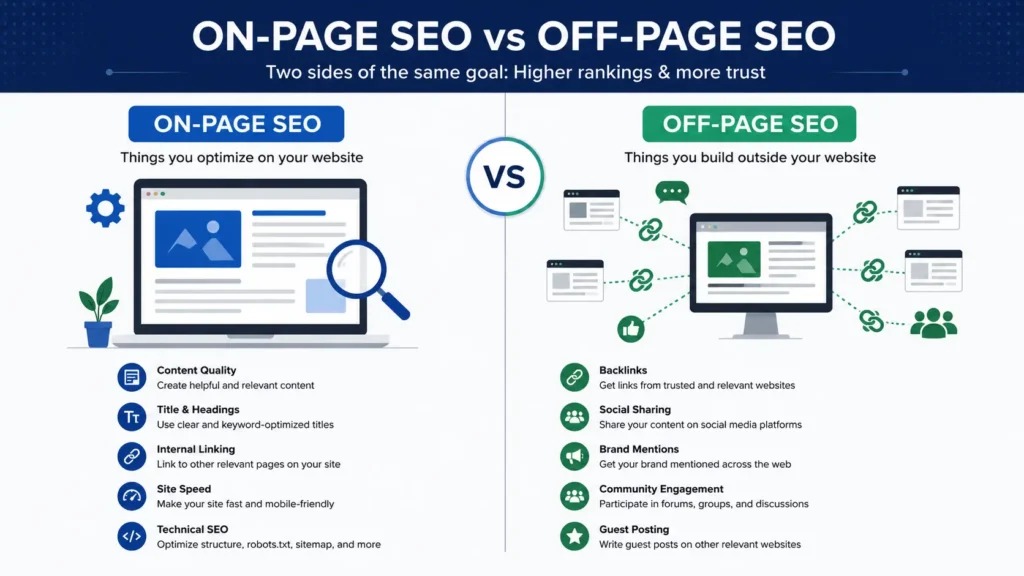
Off-page SEO means the activities you do outside your website to build trust, authority, and online reputation.
Simple words me samjhein, on-page SEO is what you improve inside your website, like title, content, headings, and internal links. But off-page SEO is about how other websites, platforms, and people interact with your website.
Off-page SEO includes:
- Backlinks
- Brand mentions
- Guest posting
- Social sharing
- Online reputation
- Forum participation
- Community engagement
- Content promotion
The main goal of off-page SEO is to build trust.
If other trusted and relevant websites mention your content or link to your website, it can send a positive signal that your website is useful.
But off-page SEO is not about shortcuts. It is about building a clean and natural online presence over time.
If you are completely new to SEO, first understand SEO basics for beginners and then come back to this off-page SEO guide.
What Are Backlinks?
A backlink is a link from another website to your website.
For example, suppose a trusted blog writes an article about SEO and adds a link to your DigitalBhai article as a helpful resource. That link is called a backlink.
Backlinks are important because they can work like a recommendation.
When a trusted and relevant website links to your content, it can help search engines understand that your page may be useful.
But one important thing:
All backlinks are not equal.
A backlink from a trusted, relevant website is much better than many low-quality links from spammy websites.
For beginners, the goal should not be to collect backlinks quickly. The goal should be to earn or build relevant and useful backlinks naturally.
Why Off-Page SEO and Backlinks Are Important
Today, many websites publish content on similar topics.
So Google does not only look at your content. It also tries to understand whether your website is trusted, useful, and connected with the right topic.
Before building backlinks, make sure your content is useful and your keyword research guide for beginners process is clear.
Off-page SEO and backlinks can help in these ways:
1. They Help Build Website Trust
When trusted websites link to your content, it can improve your website’s trust signals.
This does not mean instant ranking, but it can support your long-term SEO growth.
2. They Help Build Topical Authority
If your website gets mentions or links from websites related to blogging, SEO, WordPress, or digital marketing, it can help Google understand your topic area better.
Relevance matters a lot.
A backlink from a related website is usually more useful than a random backlink from an unrelated site.
3. They Can Bring Referral Traffic
Backlinks are not only for SEO.
If a reader clicks your link from another website and visits your blog, that is called referral traffic.
Good backlinks can send real readers to your website.
4. They Can Help Search Engines Discover Pages
Search engines can discover pages through links.
If your content is linked from other pages, it may help search engines find your content more easily.
But remember, backlinks do not guarantee indexing. Indexing also depends on content quality, technical SEO, sitemap, crawlability, and overall website health.
5. They Improve Online Presence
When your website is mentioned on relevant platforms, people slowly start recognizing your brand and may discover your helpful content over time.
Good Backlinks vs Bad Backlinks
Beginners often think that more backlinks mean better SEO.
But this is not always true.
Quality matters more than quantity.
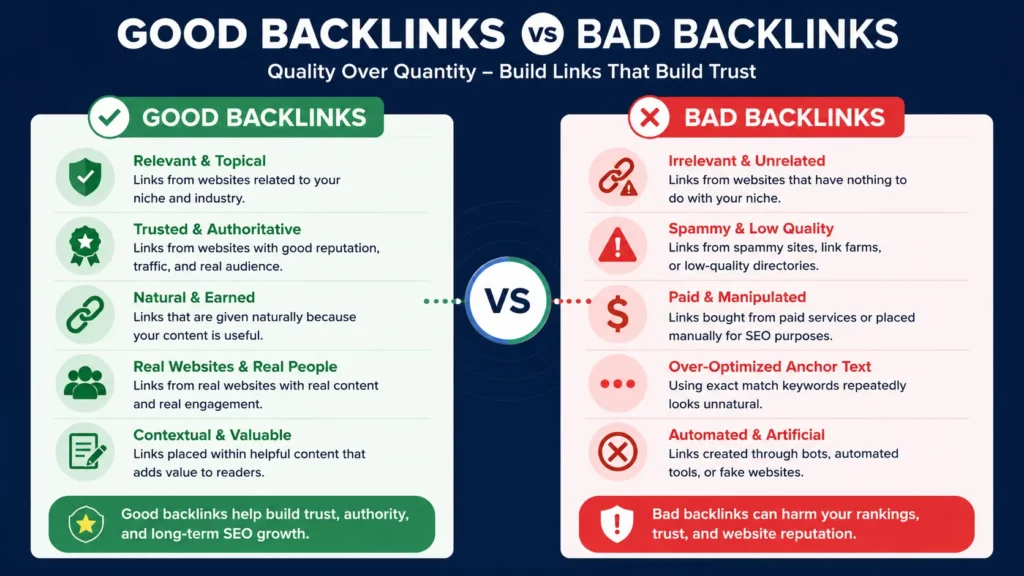
Good Backlinks
Good backlinks usually come from:
- Relevant websites
- Trusted blogs
- Helpful resource pages
- Guest posts on genuine sites
- Natural mentions
- Niche-related platforms
- Useful community discussions
A good backlink should feel natural and useful for the reader.
Example:
If a blogging website links to your guide on keyword research, that link is relevant.
Bad Backlinks
Bad backlinks usually come from:
- Spammy websites
- Irrelevant sites
- Auto-generated link farms
- Paid bulk backlink services
- Random blog comments
- Low-quality directories
- Websites created only for links
Bad backlinks can hurt trust instead of building it.
That is why beginners should avoid shortcuts like buying hundreds of backlinks.
Safe Off-Page SEO Methods for Beginners
Now let’s understand some safe and practical ways beginners can start off-page SEO.
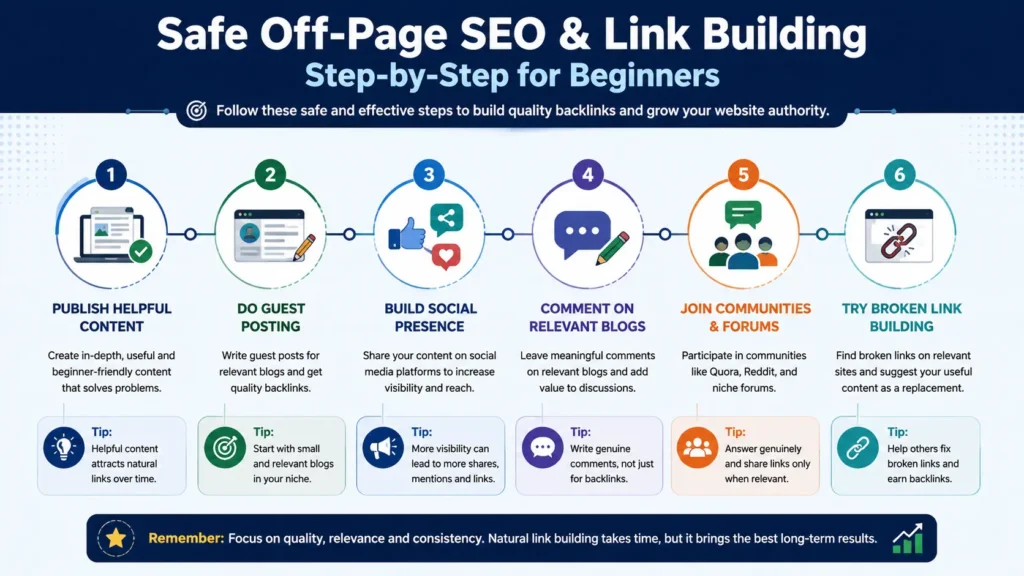
Step 1: Publish Helpful Content First
Before building backlinks, make sure your content is useful.
If your content is weak, people will not naturally link to it.
Try to create content like:
- Beginner guides
- Step-by-step tutorials
- Checklists
- Practical examples
- Simple explanations
- Problem-solving posts
For example, a useful post like “SEO Basics for Beginners” or “Keyword Research Guide for Beginners” has better chances of getting shared or linked.
Helpful content is the foundation of off-page SEO.
Step 2: Start With Small Guest Posting
Guest posting means writing an article for another website.
In return, you may get a relevant backlink or author mention.
Beginners should not directly target big websites from day one.
Start with small but genuine blogs in your niche.
Before guest posting, check:
- Is the website relevant?
- Does it publish useful content?
- Does it look genuine?
- Is the audience related to your topic?
- Is the site full of spammy links?
Guest posting should be used to share helpful content, not just to get links.
Step 3: Build Social Media Presence
Social media links may not always work like traditional SEO backlinks, but they can help your content reach more people.
When you share your blog posts on platforms like LinkedIn, Facebook, X, Pinterest, or relevant communities, more people can discover your content.
This can lead to:
- More visibility
- More readers
- More brand awareness
- Possible natural backlinks
For beginners, social media is useful for content promotion and audience building.
Step 4: Use Blog Commenting Carefully
Blog commenting can help you build relationships, but it should not be used for spam.
Do not comment only for backlinks.
Avoid comments like:
“Nice post”
“Great article”
“Visit my website”
Instead, write meaningful comments.
Example:
“Your explanation of internal linking is useful because many beginners ignore site structure. I also noticed that adding related post links can improve reader experience.”
This type of comment looks genuine and helpful.
Step 5: Participate in Relevant Communities
You can join communities where people ask questions related to blogging, SEO, WordPress, or digital marketing.
Examples:
- Quora
- Reddit communities
- Facebook groups
- LinkedIn groups
- Niche forums
Answer questions genuinely.
Only share your link when it is truly helpful and relevant.
Over-promotion can damage trust.
Step 6: Try Broken Link Building Slowly
Broken link building is a slightly advanced method.
In this method, you find a broken link on another website and suggest your similar helpful content as a replacement.
This can help both sides:
- The website owner fixes a broken link
- You may get a relevant backlink
But beginners should not rush into this.
First build useful content, then slowly try this method.
Practical Off-Page SEO Tips for Beginners
Here are some simple tips to follow:
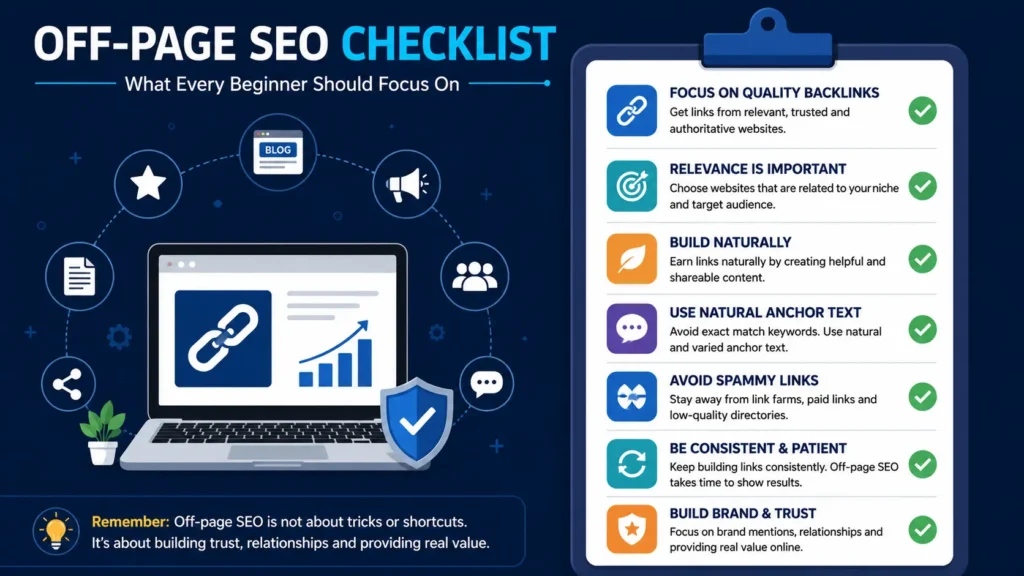
- Focus on quality, not quantity
- Build links slowly and naturally
- Choose relevant websites
- Avoid spammy backlinks
- Do not buy bulk backlinks
- Use natural anchor text
- Build relationships with other bloggers
- Share your content on useful platforms
- Keep improving your content
- Be patient
Off-page SEO takes time.
You may not see results immediately, but consistent and clean efforts can support long-term growth.
You can also use best free SEO tools to check your website performance and improve your SEO process.
Anchor Text in Backlinks
Anchor text is the clickable text of a link.
For example, if someone links to your article using the words “SEO basics for beginners,” then that phrase is the anchor text.
Anchor text should look natural.
Do not use the same exact keyword in every backlink.
Natural anchor text examples:
- Read this guide
- Learn more here
- Helpful SEO guide
- Blogging tips for beginners
- DigitalBhai article on SEO basics
If all backlinks use the exact same keyword, it may look unnatural.
Simple rule:
Keep anchor text natural, relevant, and reader-friendly.
Common Off-Page SEO Mistakes Beginners Should Avoid
Many beginners make off-page SEO risky by following shortcuts.
Many beginners also make content and planning mistakes. You can read common blogging mistakes beginners make to avoid those errors early.
Here are some common mistakes:
1. Buying Cheap Backlinks
Buying bulk backlinks from random services is risky.
These links are often low-quality, spammy, or irrelevant.
Shortcuts may look tempting, but they can harm your website’s trust in the long run.
2. Creating Spammy Comments
Dropping your link everywhere in comments is not a good strategy.
It can look spammy and damage your reputation.
Comment only when you can add real value.
3. Taking Links From Irrelevant Websites
A backlink from an unrelated website may not help much.
For example, if your blog is about SEO and blogging, then links from digital marketing, blogging, WordPress, or business websites are more relevant.
Relevance is very important.
4. Focusing Only on Backlinks
Backlinks alone cannot fix weak content, slow speed, poor structure, or bad user experience.
SEO works as a complete system.
Content, on-page SEO, technical SEO, internal linking, and off-page SEO should work together.
Backlinks work better when your on-page SEO and technical SEO are also strong.
5. Expecting Fast Results
Off-page SEO takes time.
Backlinks and trust-building do not show results overnight.
Beginners should stay consistent and avoid panic.
6. Ignoring Brand Building
Off-page SEO is not only about backlinks.
Brand mentions, social visibility, community trust, and helpful reputation also matter.
For DigitalBhai, building trust with beginners is more important than chasing random links.
FAQs About Off-Page SEO and Backlinks
What is off-page SEO in simple words?
Off-page SEO means the work you do outside your website to build trust, authority, and online reputation. It includes backlinks, brand mentions, guest posting, social sharing, and community engagement.
What are backlinks in SEO?
Backlinks are links from other websites to your website. When a trusted and relevant website links to your content, it can work like a recommendation and help build trust.
Are all backlinks good for SEO?
No. All backlinks are not good. Backlinks from trusted and relevant websites are useful, but links from spammy, irrelevant, or low-quality websites can be risky.
How can beginners build backlinks safely?
Beginners can build backlinks safely by publishing helpful content, doing genuine guest posting, sharing content on relevant platforms, answering questions in communities, and building relationships with other bloggers.
Should beginners buy backlinks?
No. Beginners should avoid buying cheap or bulk backlinks. Many paid backlink services create spammy links, which can harm your website’s trust in the long run.
Before building backlinks, beginners should also understand Google’s link spam policies so they can avoid risky link-building shortcuts.
How many backlinks do beginners need?
There is no fixed number. Quality matters more than quantity. One relevant backlink from a trusted website can be more useful than many low-quality backlinks.
How long does off-page SEO take to show results?
Off-page SEO takes time. It may take weeks or months to see visible results because trust-building, backlinks, and brand awareness grow slowly.
Next Step
Off-page SEO helps you build trust outside your website. But it works best when your content, on-page SEO, technical SEO, and internal linking are already strong.
If you are new to SEO, first understand SEO basics for beginners. Then learn keyword research guide for beginners so you can choose better topics.
After that, improve your content with on-page SEO and keep your website healthy with technical SEO.
Read next:
- SEO Basics for Beginners
- Keyword Research Guide for Beginners
- On-Page SEO Complete Guide for Beginners
- Technical SEO for Beginners
- Best Free SEO Tools for Beginners
If you are still building your blog, also read How to Start Blogging and WordPress Setup Guide for Beginners.
Conclusion
Agar simple tareeke se samjhein to, Off-Page SEO and Backlinks website ki online reputation build karne ka process hai.
Google sirf content nahi dekhta. Wo trust bhi dekhta hai.
Aur trust mostly backlinks aur online mentions se build hota hai.
Agar aap beginner ho to:
- Quality content likho
- Natural backlinks build karo
- Consistent raho
- Spam avoid karo
Bas itna hi kaafi hai strong foundation ke liye.
Yaad rakhiye:
SEO ek long-term game hai.
Overnight results ke peeche bhaagne ke bajaye learning aur consistency par focus karo.
Aaj chhota effort future mein bada traffic la sakta hai.
And finally, don’t worry if Off-Page SEO feels confusing at first — once you understand backlinks properly, everything starts making sense.
If you are a beginner and need simple help with blogging, SEO basics, WordPress setup, or blog improvement, you can connect with Digital Bhai. The goal is to help beginners learn digital skills in a simple and practical way.