
Introduction
If you are new to blogging, SEO may look confusing in the beginning.
You may hear words like keywords, ranking, backlinks, indexing, on-page SEO, technical SEO, and Google algorithm. At first, it feels like too much. But don’t worry — SEO becomes simple when you understand the basics step by step.
SEO means Search Engine Optimization. Simple words me samjhein, SEO is the process of improving your blog post or website so that Google can understand it better and show it to the right readers.
For beginners, SEO is not about tricks or shortcuts. It is about writing helpful content, choosing the right keywords, using a clear structure, improving page experience, and building trust slowly.
In this guide on SEO basics for beginners, you will learn what SEO is, how it works, why it is important, the main types of SEO, and how you can start improving your blog posts in a simple and practical way.
What is SEO?
SEO stands for Search Engine Optimization.
Simple words me samjhein, SEO means improving your website or blog post so that search engines like Google can understand your content better and show it to the right people.
For example, if someone searches “how to start blogging,” Google tries to show the most helpful and relevant pages for that topic.
SEO helps your blog become more clear, useful, and easy to understand for both readers and search engines.
But SEO is not magic. It does not guarantee instant ranking. It simply helps your content move in the right direction when your article is useful, well-structured, and matches what people are searching for.
Why SEO Is Important for Beginners
Many beginners write good blog posts, but they do not get traffic because Google does not clearly understand what the post is about.
SEO helps you fix this problem.
SEO is important because it helps you:
– Choose better topics
– Write content around real search intent
– Make your blog posts easy to read
– Use keywords naturally
– Improve your chances of getting search traffic
– Build long-term visibility
– Create trust with readers
For a beginner blogger, SEO is like a roadmap. It tells you what readers are searching for, how to structure your content, and how to make your blog easier to discover.
Without SEO, your post may still be helpful, but it can remain hidden.
How SEO Works
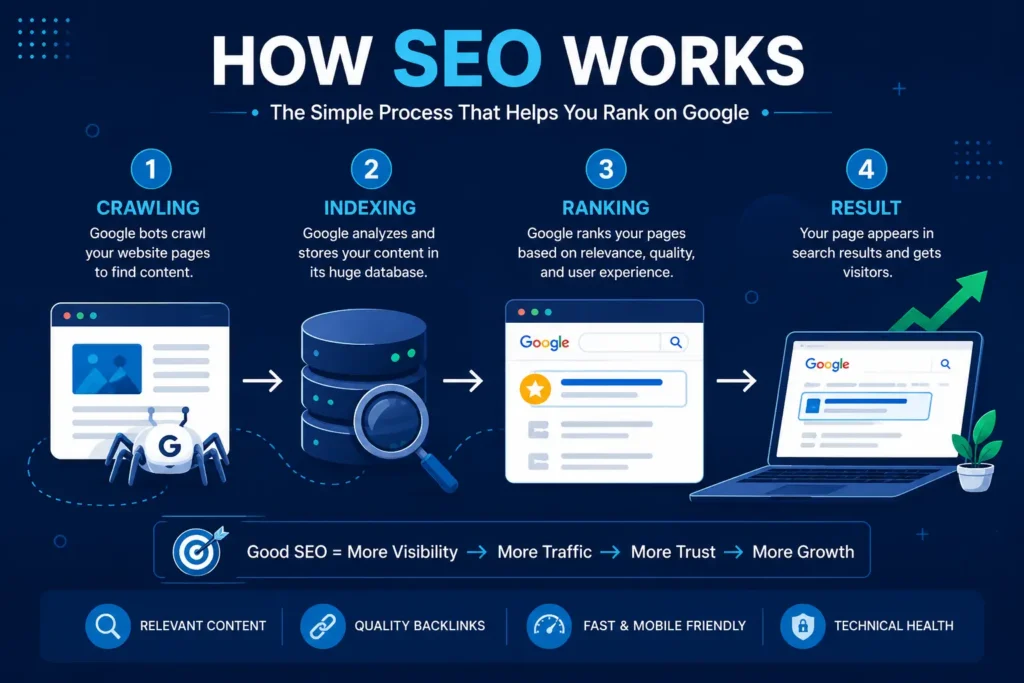
To understand SEO basics, you should first understand how Google works.
Google generally follows three important steps:
1. Crawling
Crawling means Google discovers your web pages.
Google uses bots, also called crawlers, to visit websites and find new or updated pages.
For example, when you publish a new blog post, Google needs to discover that post first.
2. Indexing
Indexing means Google stores and understands your page.
If Google can read your page properly, it may add it to its index. You can think of Google index like a big library where web pages are stored.
If a page is not indexed, it usually cannot appear in Google search results.
3. Ranking
Ranking means deciding which page should appear higher in search results.
Google looks at many signals like content quality, search intent, page experience, relevance, internal links, backlinks, and trust.
Aapko bas ye yaad rakhna hai:
Crawling means Google finds your page.
Indexing means Google stores your page.
Ranking means Google decides where your page should appear.
Main Types of SEO
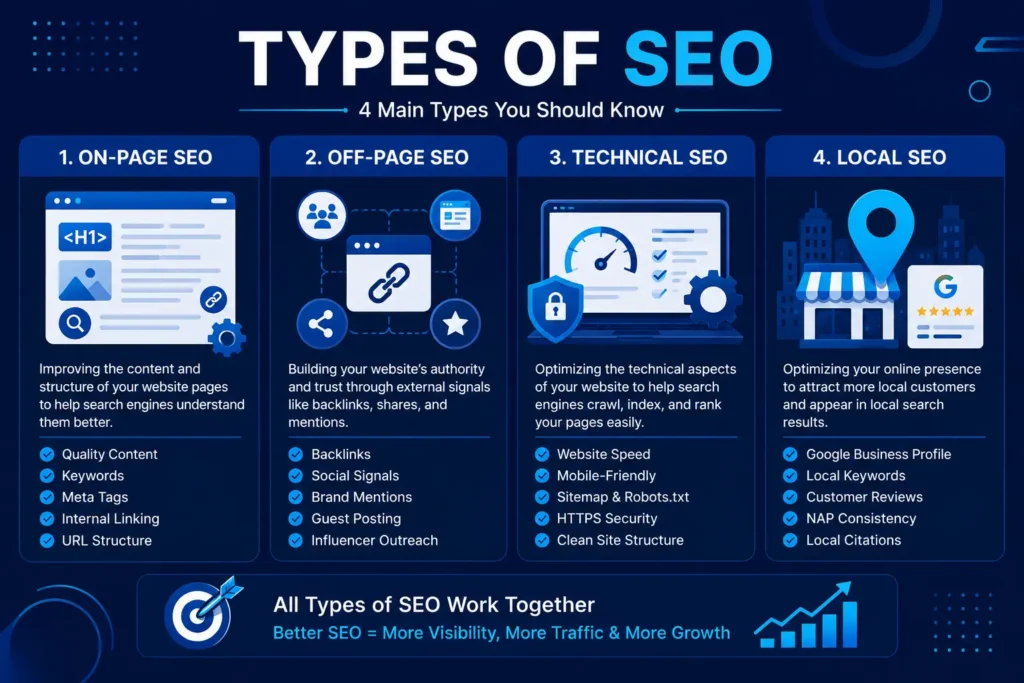
SEO has different parts. As a beginner, you do not need to master everything in one day. But you should understand the basic role of each type.
On-Page SEO
On-page SEO means improving the content and structure of your blog post.
It includes your title, headings, meta description, keyword placement, image alt text, internal links, URL structure, and content quality.
For example, if your post is about “SEO basics for beginners,” your title, intro, headings, and content should clearly explain that topic.
On-page SEO helps Google understand your page and helps readers enjoy a better reading experience.
If you want to learn this deeply, read this detailed guide: On-Page SEO Complete Guide for Beginners.
Off-Page SEO
Off-page SEO means building trust and authority outside your website.
The most common part of off-page SEO is backlinks. A backlink means another website links to your website.
If a trusted website links to your article, it can send a positive trust signal. But beginners should not run behind backlinks from day one.
First, focus on helpful content, clear structure, internal links, and consistency.
To understand backlinks and website authority better, read this guide: Off-Page SEO and Backlinks Explained Simply for Beginners.
Technical SEO
Technical SEO means improving the technical health of your website.
It includes website speed, mobile-friendly design, sitemap, indexing, HTTPS security, clean website structure, and fixing errors in Google Search Console.
Technical SEO helps Google crawl, index, and understand your website smoothly.
Beginner level par, you should focus on keeping your website fast, mobile-friendly, secure, and easy to navigate.
For a deeper step-by-step explanation, read this guide: Technical SEO for Beginners.
Local SEO
Local SEO helps a business or service appear in local searches.
For example, if someone searches “website designer near me,” “SEO service in Patna,” or “digital marketing service near me,” Google tries to show local and relevant results.
Local SEO is useful for shops, coaching centers, restaurants, clinics, freelancers, service providers, and local businesses.
Important parts of Local SEO include Google Business Profile, customer reviews, local keywords, business name, address, phone number, and location-based pages.
For normal bloggers, Local SEO may not be very important in the beginning. But if you offer services like website setup, SEO help, or digital marketing support, Local SEO can help you get local clients.
Simple words me samjhein, Local SEO helps nearby people find your business or service online.
What Are Keywords in SEO?
Keywords are the words or phrases that people search on Google.
For example:
– SEO basics for beginners
– how to start blogging
– keyword research for beginners
– best free SEO tools
– common blogging mistakes
If you understand keywords, you can understand what your readers want.
But keyword use should always be natural. Do not repeat the same keyword again and again just to increase SEO score.
A good keyword helps you choose the right topic. Helpful content helps you satisfy the reader.
That is why keyword research is an important part of SEO, but it is not the full SEO process.
There are many tools available online for keyword research that you can use to determine the right keywords for SEO results. Like – Google Keyword Planner, Ubersuggest, Ahrefs,AnswerThePublic, Google Trends etc.
Basic SEO Steps for Beginners
Now let’s understand a simple SEO process that beginners can follow.
Step 1: Choose One Clear Topic
Do not write on random topics.
Choose one clear topic that your target readers are searching for.
For example, instead of writing only “SEO,” you can write “SEO basics for beginners.” This is more specific and easier for beginners to understand.
Step 2: Find a Main Keyword
Choose one main keyword for your blog post.
Your main keyword should match the topic and reader intent.
For example, for this post, the main keyword is “seo basics for beginners.”
Step 3: Understand Search Intent
Search intent means the real reason behind a search.
Before writing, ask yourself:
What does the reader want?
Do they want a definition?
Do they want a step-by-step guide?
Do they want a tool list?
Do they want a comparison?
Do they want a solution?
If your content matches search intent, your article becomes more useful.
Step 4: Write Helpful Content
SEO does not mean writing only for Google.
Your first focus should be the reader.
Write content that is:
– Clear
– Practical
– Easy to understand
– Well-structured
– Honest
– Useful
Google also wants to show helpful content to users. So reader-first content is always better for long-term SEO.
Step 5: Use Headings Properly
Headings make your blog easy to read.
Use one main title as H1.
Use H2 for main sections.
Use H3 for smaller points under a section.
Good headings help readers scan your article quickly. They also help Google understand your content structure.
Step 6: Add Internal Links
Internal links connect one post of your website to another post.
For example, if you are explaining keywords, you can link to your keyword research guide. If you are explaining blogging, you can link to your blogging guide.
Internal links help readers explore more helpful content on your site. They also help Google understand the relationship between your posts.
Step 7: Optimize Images
Images make your blog attractive and easy to understand.
But images should be optimized properly.
Use:
– Compressed images
– Clear file names
– Relevant alt text
– Proper placement inside the article
Alt text helps search engines understand what the image is about. It also improves accessibility.
Step 8: Improve Page Experience
Page experience means how comfortable your blog is for readers.
A good page experience includes:
– Fast loading speed
– Mobile-friendly design
– Easy navigation
– Clean font
– Proper spacing
– No unnecessary popups
A blog should not only look good. It should also feel easy to read.
Common SEO Mistakes Beginners Should Avoid
Many beginners make SEO complicated because they focus on tricks instead of basics.
Here are some common mistakes:
1. Keyword Stuffing
Keyword stuffing means repeating the same keyword too many times.
This makes content look unnatural.
Use keywords naturally. Write for humans first.
2. Ignoring Search Intent
Sometimes beginners choose a keyword but do not understand what the reader actually wants.
If the keyword is “SEO basics for beginners,” the reader wants a simple explanation, not advanced technical theory.
3. Depending Only on SEO Plugin Score
Tools like Rank Math are helpful, but they are not the final judge of content quality.
A green score is good, but reader satisfaction is more important.
4. Writing Without Structure
A long article without headings, examples, and proper flow becomes difficult to read.
Use short paragraphs, headings, bullet points, and examples.
5. Expecting Fast Results
SEO takes time.
New blogs usually need consistency, helpful content, indexing, internal linking, and patience.
Do not expect instant ranking after publishing one or two posts.
6. Mobile Optimization
Beginners should also pay attention to mobile optimization.
Nowadays, most users view websites on their smartphones, so it’s important that your website is mobile-friendly.
If your site doesn’t work properly on mobile, users may abandon quickly, leading to an increased bounce rate.
7. Quality Content
Many beginners focus solely on search engines rather than the quality of their content.
However, if you don’t consider users, the content they visit your site for, they’ll leave immediately if they’re not satisfied.
Google always prioritizes helpful, informative, and user-focused content.
8. Website Speed
And finally, it’s crucial to pay attention to your website’s speed, as a slow load can annoy users, which can harm your SEO and reduce your chances of ranking higher.
Avoiding these mistakes will help you to build a strong foundation and improve your website’s performance over time.
Simple SEO Tips for Beginners
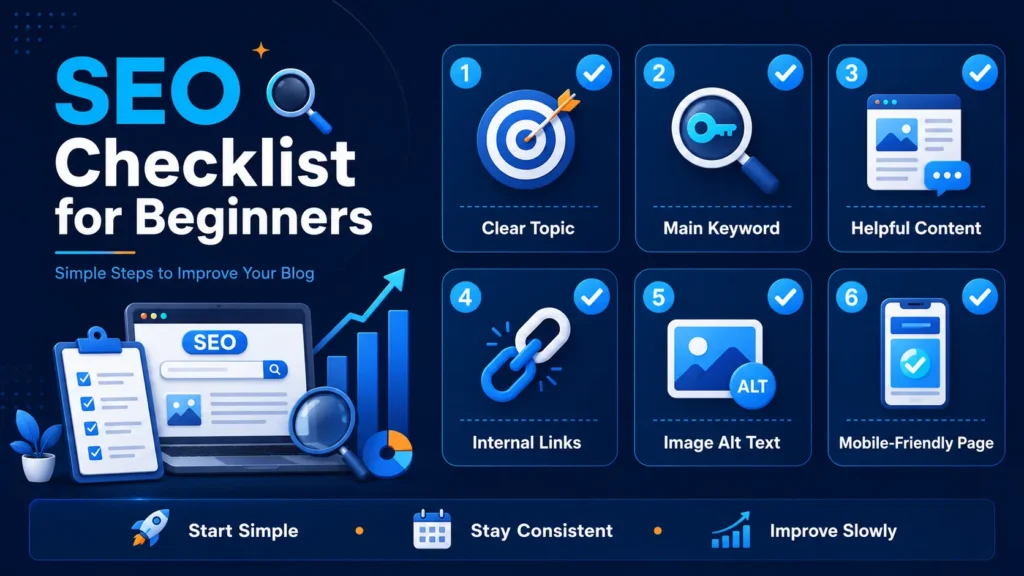
If you are just starting, focus on these simple SEO habits:
– Choose one clear topic for each post
– Use one main keyword naturally
– Write a helpful intro
– Use clear H2 and H3 headings
– Add internal links to related posts
– Compress images before uploading
– Add image alt text
– Write a useful meta description
– Keep your content updated
– Track performance in Google Search Console
SEO becomes easier when you practice it regularly.
Do not try to learn everything in one day. Start with the basics, improve one post at a time, and keep learning from your results.
FAQs About SEO Basics for Beginners
What is SEO in simple words?
SEO means Search Engine Optimization. Simple words me samjhein, SEO is the process of improving your website or blog post so that Google can understand it better and show it to the right readers.
Why is SEO important for beginners?
SEO is important because it helps beginners write content in the right direction. It helps you choose better topics, use keywords naturally, improve content structure, and increase your chances of getting organic traffic over time.
Can I learn SEO without technical knowledge?
Yes, you can learn basic SEO without advanced technical knowledge. In the beginning, focus on helpful content, keyword research, headings, internal links, image alt text, mobile-friendly design, and Google Search Console.
What are the main types of SEO?
The main types of SEO are on-page SEO, off-page SEO, technical SEO, and local SEO. On-page SEO improves your content, off-page SEO builds trust through backlinks, technical SEO improves website health, and local SEO helps local businesses appear in nearby searches.
How long does SEO take to show results?
SEO usually takes time. A new blog may take weeks or months to see visible results, depending on content quality, competition, indexing, consistency, and website trust. SEO is a long-term process, not an instant result system.
Is Rank Math score enough for SEO?
No. Rank Math score is helpful, but it is not the final proof of good SEO. A good score can guide you, but your content should also be useful, clear, original, and written for real readers.
What should beginners learn after SEO basics?
After SEO basics, beginners should learn keyword research, on-page SEO, technical SEO, internal linking, Google Search Console, and content writing. These skills help you improve your blog step by step.
Next Step
SEO basics are only the starting point. Once you understand how SEO works, the next step is to apply it properly inside your blog posts.
First, learn how to find the right keywords through keyword research. Then understand how to use those keywords naturally with on-page SEO. After that, improve your website health with technical SEO and build trust slowly with off-page SEO.
Read next:
- Keyword Research Guide for Beginners
- On-Page SEO Complete Guide for Beginners
- Technical SEO for Beginners
- Off-Page SEO and Backlinks Explained Simply for Beginners
- Best Free SEO Tools for Beginners
If you are building your first blog, also read How to Start Blogging and WordPress Setup Guide for Beginners.
Conclusion
Learning SEO basics for beginners is the first step toward building a stronger online presence.
When you understand keywords, search intent, content structure, internal links, technical SEO, and helpful content, your blog becomes easier for readers and search engines to understand.
SEO does not give instant results, but it gives your blog a better direction. With regular practice, useful content, and slow improvement, you can build traffic, trust, and long-term growth over time.
If you are a beginner and need simple help with blogging, WordPress setup, SEO basics, or content improvement, you can connect with Digital Bhai. The goal is to help beginners understand digital skills in a simple and practical way.