

Introduction
The Easy Guide to Keyword Research for SEO Beginners
You may write a helpful blog post, but if nobody is searching for that topic, your post may not get traffic.
Keyword research is one of the most important steps before writing a blog post. Many beginners write articles based only on their own ideas, but later they feel disappointed when nobody reads them.
This usually happens because they did not check what people are actually searching for.
Agar aap beginner ho, to don’t worry. Keyword research does not mean using complicated SEO tools from day one. It simply means finding the words, questions, and topics that your target readers are already searching on Google.
For example, instead of writing a random post on “blogging,” you can find a clear topic like “how to start blogging for beginners” or “common blogging mistakes beginners make.”
In this keyword research guide for beginners, we will understand how to find useful blog topics, check search intent, understand competition, and use keywords naturally without stuffing them.
This keyword research guide for beginners will help you choose better topics before writing your blog posts.
Table of Contents
What is Keyword Research
Keyword research means finding the words, questions, and topics that people search on Google before writing your blog post.
For example, a beginner may search:
- how to start blogging
- keyword research for beginners
- best free SEO tools
- common blogging mistakes
- how bloggers make money
These search terms are called keywords.
But keyword research is not only about finding popular words. It is about understanding what the reader wants and then writing content that solves that problem clearly.
Simple words me samjhein, keyword research helps you answer this question:
“What should I write so that the right readers can find my blog?”
Why Keyword Research is Important

Many beginners write posts based only on personal ideas. Sometimes those ideas are good, but if people are not searching for them, traffic can be very low.
Keyword research gives your blog direction.
It helps you:
- Find topics people are already searching for
- Understand reader problems
- Avoid writing random posts
- Choose beginner-friendly topics
- Plan related articles
- Improve SEO naturally
- Build traffic slowly over time
For example, instead of writing a broad post on “SEO,” a beginner can write on “SEO basics for beginners.” This keyword is more specific, easier to understand, and better matched with beginner search intent.
Keyword research does not guarantee instant ranking. But it helps you write in the right direction.
How to Do Keyword Research Step by Step
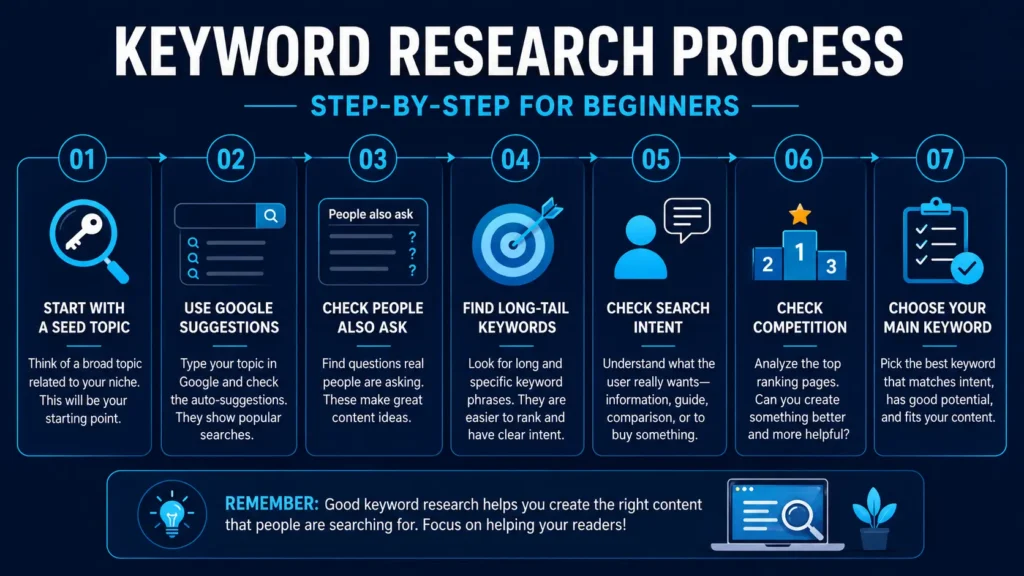
Now let’s understand the keyword research process step by step, so you can follow it even if you are completely new to SEO.
Keyword research becomes easier when you follow a simple process. You do not need expensive tools in the beginning. First, learn how to think like your reader.
If you are still new to blogging, first understand how to start blogging, choose a profitable blogging niche, avoid common blogging mistakes beginners make, and then improve your SEO basics step by step.
Step 1: Start With a Seed Topic
A seed topic is the main topic you want to write about.
For example:
- blogging
- SEO
- WordPress
- AI tools
- online earning
Seed topic is broad. Your job is to make it more specific.
For example, “blogging” can become:
how bloggers make money
how to start blogging for beginners
common blogging mistakes
blogging niche ideas
Step 2: Use Google Suggestions
Go to Google and type your topic slowly. Google will show automatic suggestions.
For example, if you type “keyword research,” you may see suggestions like:
- keyword research for beginners
- keyword research tools
- keyword research for SEO
- keyword research for blog posts
These suggestions show what people are commonly searching for.
Step 3: Check People Also Ask
The “People Also Ask” section gives real questions from users.
These questions are useful because they help you understand what readers are confused about.
For example:
- What is keyword research?
- How do beginners do keyword research?
- Which keyword research tool is free?
- How many keywords should I use in a blog post?
You can use these questions in your headings, FAQ section, or content plan.
Step 4: Find Long-Tail Keywords
Long-tail keywords are longer and more specific search phrases.
For example:
Broad keyword: SEO
Long-tail keyword: SEO basics for beginner bloggers
Broad keyword: blogging
Long-tail keyword: common blogging mistakes beginners make
For a new blog, long-tail keywords are usually better because the reader intent is clear and the competition may be lower.
Step 5: Check Search Intent

Search intent = what the user wants.
Search intent means the real reason behind a search.
Before writing, ask:
- Does the reader want information?
- Does the reader want a step-by-step guide?
- Does the reader want a tool?
- Does the reader want a comparison?
- Does the reader want to buy something?
If your content does not match search intent, ranking becomes difficult even if your keyword is good.
Step 6: Check Competition
Open the top results on Google and see what kind of content is already ranking.
Check:
- Are the top posts very detailed?
- Are they from big websites?
- Are they answering the question properly?
- Can you explain the topic in a simpler and more useful way?
- Can you add beginner-friendly examples?
Competition is not always bad. It tells you that people are interested in the topic. But as a beginner, avoid targeting only very broad keywords.
Step 7: Choose One Main Keyword
For one blog post, choose one main keyword.
Then use related keywords naturally in the content.
Do not try to target 5–10 main keywords in one post. This can make your content confusing and keyword-stuffed.
A good keyword should be clear, relevant, beginner-friendly, and connected to your post topic.
How to Use Keywords Naturally in a Blog Post
After choosing your keyword, the next step is using it properly.
Do not repeat the keyword again and again just to increase SEO score. This makes the content robotic and difficult to read.
Use your main keyword naturally in important places like:
- Title
- First paragraph
- One or two headings
- Meta description
- Image alt text
- URL, if possible
- Conclusion, if natural
For example, if your keyword is “keyword research guide for beginners,” you can use it naturally in the intro and one heading. But you do not need to repeat the full phrase in every paragraph.
Also use related words like:
- keyword ideas
- search intent
- long-tail keywords
- SEO topics
- blog topic ideas
- competition check
This helps your content sound natural and complete.
Practical Tips
Here are a few simple keyword research tips that can help you choose better topics and write more focused blog posts:
✔ Start with low competition keywords
✔ Use one main keyword and a few related keywords
✔ Think like your reader, not just like a search engine
✔ Answer real questions people are asking
✔ Keep your content simple, clear, and genuinely helpful
Simple tareeke se samjhein to…
Write for readers first, then optimize for search engines. If your content solves the reader’s problem clearly, your SEO efforts become much more meaningful.
Common Keyword Research Mistakes Beginners Should Avoid
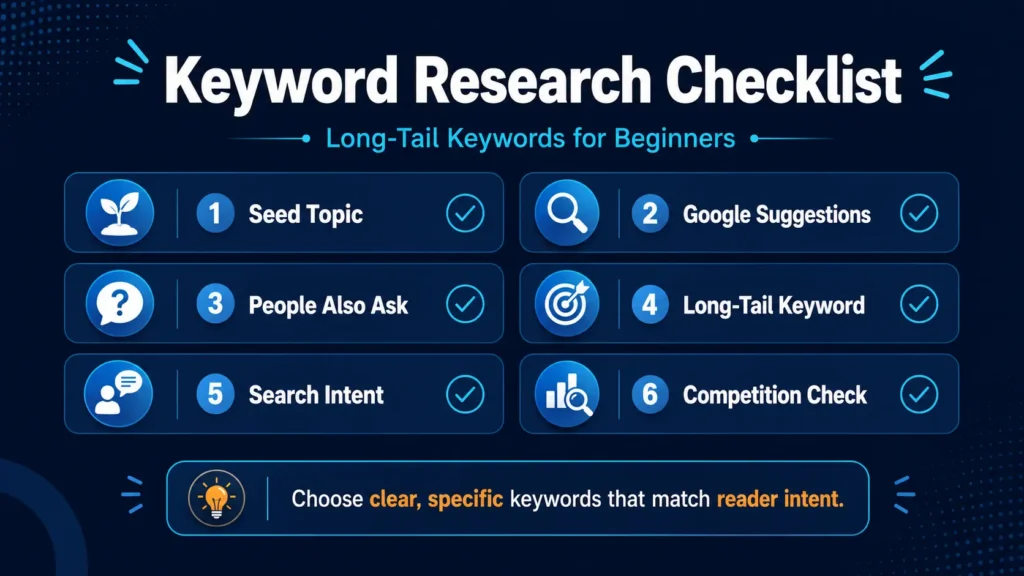
Many beginners make the same keyword research mistakes in the beginning. If you avoid these mistakes, your content planning will become much clearer and more effective.
Beginners often make these mistakes:
- Choosing very broad keywords like “SEO” or “blogging”
- Ignoring search intent
- Selecting keywords only because search volume looks high
- Copying keywords from big websites without checking competition
- Changing focus keywords again and again
- Using too many keywords in one post
- Writing for SEO tools instead of real readers
The simple rule is this:
Choose a keyword that matches your reader’s problem, then write the best simple answer you can.
Keyword research should guide your content. It should not make your writing unnatural.
FAQs
Keyword research means finding the words, questions, and topics that people search on Google. It helps you understand what your target readers want to know before you write a blog post.
For beginners, keyword research is not about using advanced tools only. It is about choosing the right topic, understanding search intent, and writing helpful content around that topic.
Keyword research helps beginners avoid random writing. If you write only what you like without checking search demand, your post may not get traffic.
With keyword research, you can find topics people are already searching for, understand reader problems, and create content that has a better chance of getting impressions and clicks over time
Beginners can start with free methods. Type your main topic in Google and check Google suggestions, People Also Ask questions, and related searches.
You can also use tools like Google Trends, Google Keyword Planner, Google Search Console, and free SEO tools to find keyword ideas. In the beginning, focus more on clear reader intent than only search volume.
Long-tail keywords are longer and more specific search phrases.
For example, “SEO” is a broad keyword, but “SEO basics for beginner bloggers” is a long-tail keyword.
Long-tail keywords are useful for new blogs because they are more specific, easier to understand, and often have clearer search intent.
For one blog post, choose one main keyword. After that, use related keywords naturally.
Do not try to target too many main keywords in one article. This can make your content confusing and keyword-stuffed. A better approach is to focus on one clear topic and answer it properly.
Paid tools can be helpful, but they are not necessary in the beginning.
As a beginner, you can start with free tools and Google search results. First learn how to understand search intent, competition, and reader problems. Paid tools become more useful when you already understand the basics.
The biggest mistake is choosing keywords only because they look popular.
A keyword should match your reader’s problem, your blog topic, and your content level. Beginners should avoid very broad keywords and focus on specific, helpful, beginner-friendly topics.
Next Step
Keyword research helps you choose the right topic. But after choosing a keyword, the next step is using it properly inside your blog post.
So after this guide, your next focus should be on writing helpful content, using keywords naturally, adding internal links, and improving on-page SEO.
Read next: On-Page SEO Complete Guide for Beginners
You can also check: Best Free SEO Tools for Beginners if you want simple tools to find keywords, check SEO, and improve your blog posts.
Conclusion
Keyword research may feel confusing in the beginning, but with regular practice, it becomes a simple habit. Start with one topic, find a few useful keywords, understand the search intent, and then create content that truly helps your readers.
Agar aap beginner ho to… start small. Pick a topic, find keywords, and create helpful content.
You don’t need to be perfect. You just need to start.
Use this keyword research guide for beginners as a simple checklist before planning your next blog post.
Take action today: choose one topic, find a few beginner-friendly keywords, and write a helpful blog post around them. The more you practice keyword research, the better you will become at choosing topics that can bring real traffic over time.
Consistency will bring results. 🚀