
Introduction
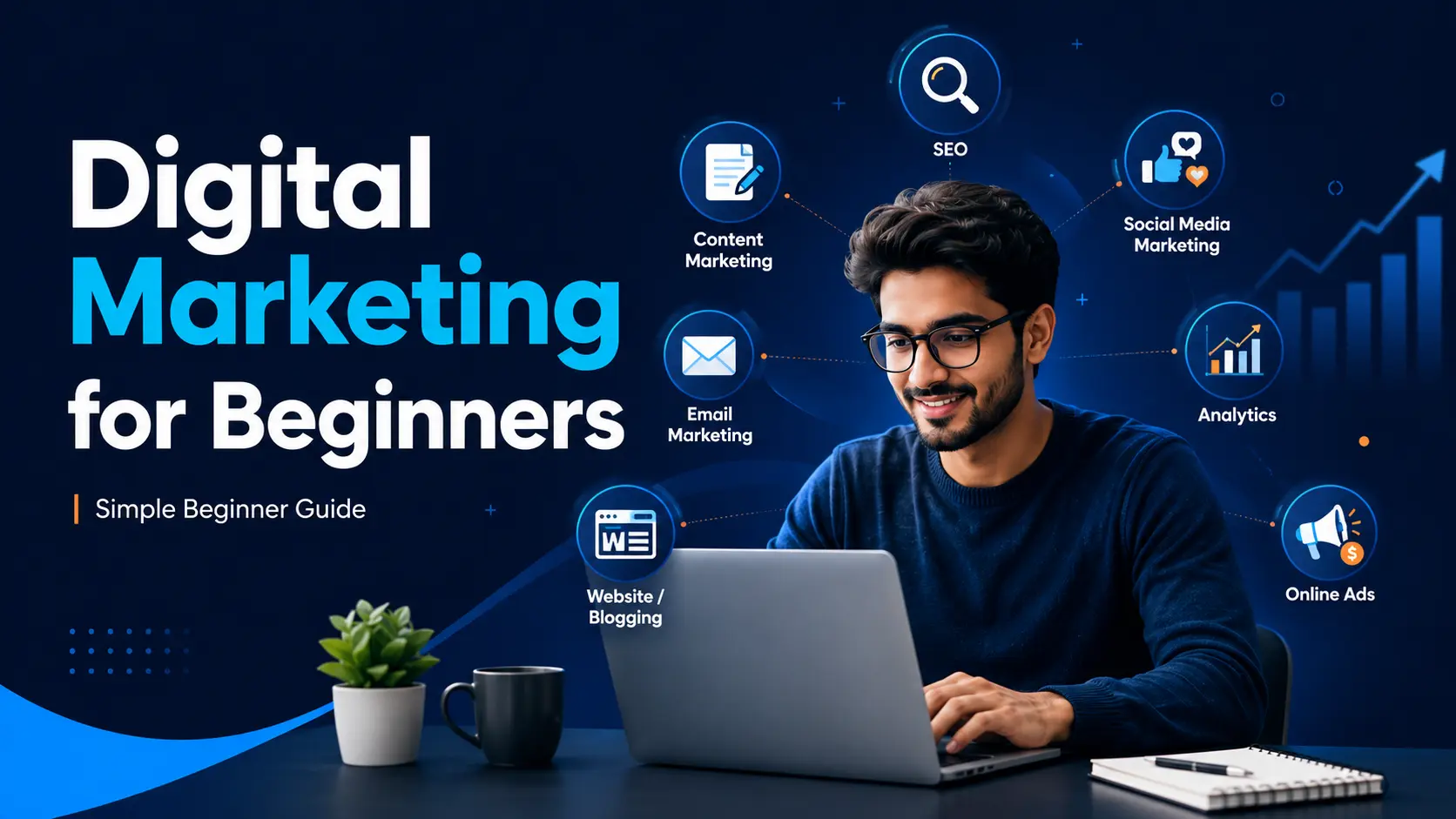
Digital marketing for beginners can feel confusing at first because it includes many things like SEO, social media, content, email, ads, websites, and online tools.
But the simple meaning is this: digital marketing means promoting a product, service, brand, or content using online platforms.
For example, when a business appears on Google, shares helpful posts on social media, sends useful emails, runs online ads, or publishes blog content to reach the right people, it is using digital marketing.
Digital marketing is not a shortcut to quick income. It is a practical skill. Pehle basics samajhna padta hai, phir practice karni padti hai, aur slowly experience build hota hai.
In this beginner-friendly guide, you will learn what digital marketing is, how it works, its main types, simple examples, important skills, and a step-by-step roadmap to start learning it.
Table of Contents
What Is Digital Marketing?
Digital marketing means using online platforms to promote a product, service, brand, website, or content.
In simple words, when marketing happens through the internet or digital channels, it is called digital marketing.
For example, when someone searches on Google and finds a business website, that is connected to digital marketing. When a brand shares useful posts on Instagram, sends emails to customers, runs YouTube ads, or writes blog posts to attract readers, all these activities are part of digital marketing.
Traditional marketing usually happens through offline channels like newspapers, banners, posters, TV, radio, or billboards. Digital marketing happens through online channels like Google, websites, blogs, social media, email, online ads, and video platforms.
The main goal is simple:
Reach the right people, share the right message, and help them take the right action.
That action can be reading a blog post, visiting a website, subscribing to an email list, buying a product, contacting a business, or learning more about a service.
Digital Marketing Meaning in Simple Words
Digital marketing is not only about selling something online.
It is also about building awareness, trust, and connection with people.
For example, if someone wants to learn how to start a blog, they may search on Google, read a helpful guide, and slowly trust that website. Later, they may subscribe, read more posts, or contact the website owner for help.
This complete journey is connected to digital marketing.
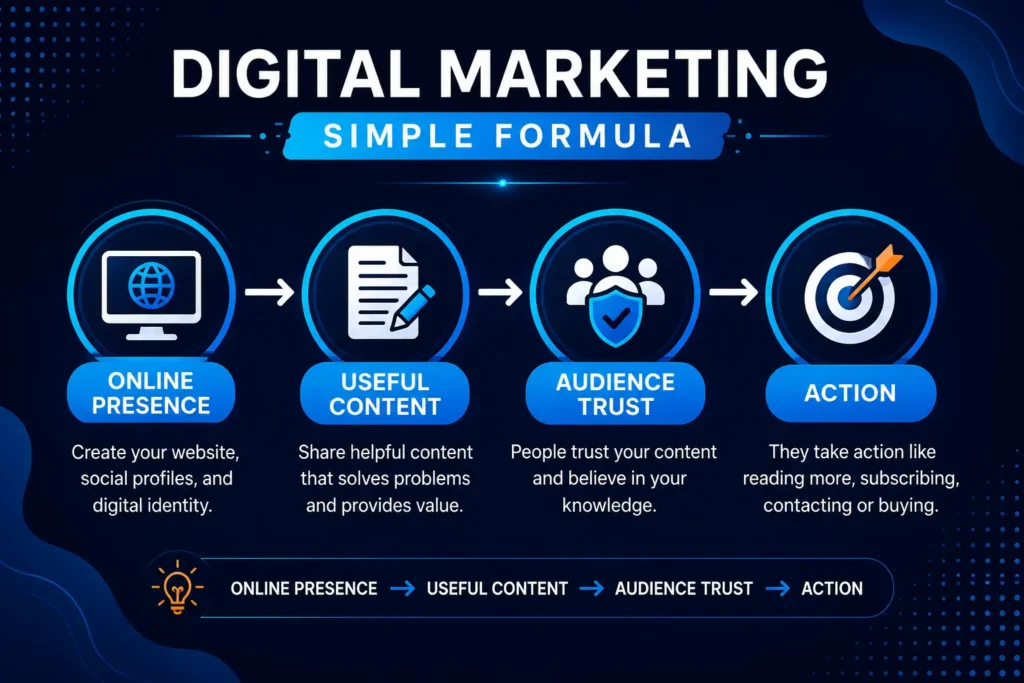
A simple formula is:
Online Presence → Useful Content → Audience Trust → Action
First, you create an online presence. Then you publish useful content. Slowly, people start trusting your content. After that, they may take action.
This is why digital marketing for beginners should start with basics, not shortcuts.
Traditional Marketing vs Digital Marketing
To understand digital marketing clearly, compare it with traditional marketing.
Traditional marketing includes things like newspaper ads, pamphlets, banners, TV ads, radio ads, and hoardings. These methods can still work, but they are usually costly and difficult to measure properly.
Digital marketing is different because it happens online. You can promote through websites, search engines, social media, email, blogs, videos, and online ads.
The biggest advantage of digital marketing is tracking.
For example, with digital tools, you can check:
- How many people visited your website
- Which blog post received traffic
- Which keyword brought visitors
- Which social media post performed better
- How many people clicked your link
- Which campaign gave results
In traditional marketing, tracking is limited. But in digital marketing, you can measure many things and improve your strategy step by step.
This makes digital marketing useful for bloggers, small businesses, freelancers, creators, and companies.
Why Digital Marketing Is Important Today
Today, people use the internet before making many decisions.
They search on Google before buying a product. They watch YouTube videos before learning a skill. They check reviews before choosing a service. They follow brands on social media before trusting them.
This is why digital marketing has become important.
If a business or creator is not visible online, many potential customers or readers may never discover them.
Digital marketing helps in many ways:
- It helps people find your website or brand online.
- It helps you explain your product, service, or content clearly.
- It helps build trust through helpful content.
- It helps connect with the right audience.
- It helps track performance and improve decisions.
- It can support long-term growth when done consistently.
For bloggers, digital marketing is even more important because blogging itself depends on content, SEO, audience building, and trust.
A blog without digital marketing is like a shop without a signboard. Content may be good, but people need a way to discover it.
Main Types of Digital Marketing
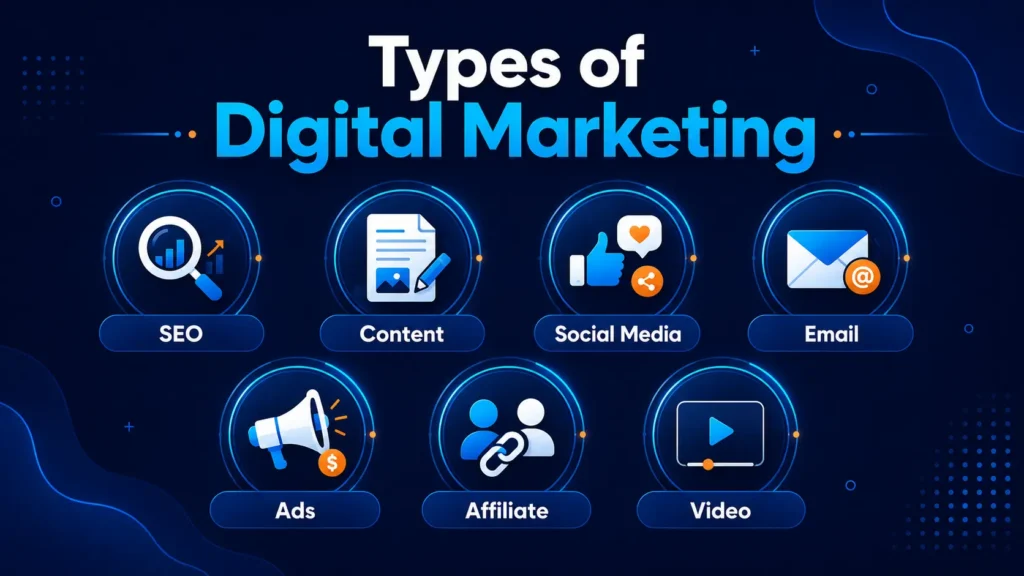
Digital marketing has many parts. As a beginner, you do not need to master everything at once. First, understand the basic types.
1. Search Engine Optimization
Search Engine Optimization, or SEO, means improving your website and content so search engines can understand it better.
When people search on Google, SEO helps your content appear for relevant searches.
For example, if you write a post about “SEO basics for beginners,” SEO helps Google understand that your post is about beginner-level SEO.
SEO includes things like:
- Keyword research
- Helpful content
- Proper headings
- Internal linking
- Image alt text
- Page speed
- Mobile-friendly design
- Technical website health
SEO is very important for bloggers because it can bring organic traffic without paying for every click.
But SEO takes time. It is not an instant result method. You need useful content, patience, consistency, and regular improvement.
After keyword research, beginners should also learn on-page SEO because it helps improve title, headings, content structure, internal links, and image optimization.
Technical SEO also helps search engines crawl, understand, and index your website properly.
2. Content Marketing
Content marketing means creating useful content to attract and help your target audience.
This content can be in different formats:
- Blog posts
- Guides
- Checklists
- Videos
- Infographics
- Emails
- Social media posts
- Case studies
For example, if you write a beginner-friendly guide about WordPress setup, that is content marketing. You are helping readers solve a problem. Slowly, this builds trust.
Content marketing works best when the content is genuinely useful.
The goal is not only to publish more content. The goal is to publish content that solves real problems.
3. Social Media Marketing
Social media marketing means using platforms like Instagram, Facebook, LinkedIn, X, Pinterest, or YouTube to connect with people and promote content.
For beginners, social media can help in:
- Sharing blog posts
- Building personal brand
- Talking with audience
- Understanding reader questions
- Promoting useful content
- Bringing traffic to website
But social media should not be used only for random posting.
A good social media strategy starts with understanding your audience. What do they want to learn? What problems do they face? What type of content helps them?
For example, a beginner blogger can share short tips about SEO, blogging mistakes, WordPress setup, or content writing. These small posts can bring people back to the blog.
4. Email Marketing
Email marketing means building a list of subscribers and sending helpful emails to them.
This is powerful because social media reach can change anytime, but an email list gives you a direct connection with your audience.
Through email, you can share:
- New blog posts
- Useful tips
- Free resources
- Checklists
- Updates
- Product or service information
For beginners, email marketing can start very simply.
You do not need a complicated system in the beginning. You can offer a useful free resource like a blogging checklist, SEO checklist, or WordPress setup checklist and ask interested readers to subscribe.
Email marketing is not about spamming people. It is about building trust through useful communication.
5. Paid Advertising
Paid advertising means paying platforms to show your ads to the right audience.
Examples include:
- Google Ads
- Facebook Ads
- Instagram Ads
- YouTube Ads
- LinkedIn Ads
Paid ads can bring quick visibility, but they need budget, testing, and proper strategy.
Beginners should be careful with paid ads. If your website, landing page, offer, or message is not clear, money can be wasted easily.
Before running ads, it is better to understand your audience, content, and goal.
Paid ads can support growth, but they should not replace good content, SEO, and trust-building.
6. Affiliate Marketing
Affiliate marketing means promoting another company’s product or service and earning a commission when someone buys through your affiliate link.
For example, a blogger may recommend a hosting service, SEO tool, WordPress theme, or useful software.
Affiliate marketing can work well in digital marketing, but honesty is very important.
Do not recommend a product only because it gives commission. Recommend only when the product is useful for your audience.
Trust is more valuable than one sale.
For beginner bloggers, affiliate marketing can be useful later, but first they should focus on helpful content and genuine recommendations.
7. Video Marketing
Video marketing means using videos to educate, explain, promote, or build trust.
Platforms like YouTube, Instagram Reels, Facebook, and short video apps make video marketing very popular.
Video content can be used for:
- Tutorials
- Product explanations
- Reviews
- Short tips
- Case studies
- Personal brand building
- Educational content
For example, if you create a short video explaining “what is SEO,” that is video marketing.
Video builds connection because people can see your face, hear your voice, or understand the topic visually.
But beginners should not feel pressure to start everything at once. If you are comfortable with writing, start with blog content. Later, you can convert blog ideas into videos.
How Digital Marketing Works
Digital marketing works through a simple process.
First, you identify your target audience. This means understanding who you want to help.
For example:
- Beginner bloggers
- Small business owners
- Students
- Freelancers
- Local shop owners
- Website owners
Second, you understand their problems.
What are they searching for? What questions do they have? What confusion are they facing?
Third, you create useful content or offers.
This can be a blog post, video, social media post, email, landing page, or service page.
Fourth, you bring people to your content using channels like SEO, social media, email, or ads.
Fifth, you build trust.
If your content is helpful, clear, and honest, people may return again.
Sixth, you guide them toward an action.
That action can be reading another post, subscribing, contacting you, buying a product, or learning more.
Simple process:
Audience → Problem → Content → Traffic → Trust → Action
This is the basic working system behind digital marketing.
Digital Marketing Examples for Beginners
Let’s understand with simple examples.
A local bakery creates an Instagram page and shares photos of cakes, customer reviews, and special offers. This is social media marketing.
A blogger writes an article about “how to start blogging” and gets traffic from Google. This is SEO and content marketing.
A small business sends weekly emails to customers with tips and offers. This is email marketing.
A YouTuber creates tutorial videos and adds links to useful tools. This can be video marketing and affiliate marketing.
A coaching teacher runs Google Ads for online classes. This is paid advertising.
A WordPress blogger writes a comparison of hosting services and uses genuine affiliate links. This is affiliate marketing.
These examples show that digital marketing is not one single thing. It is a combination of different online methods used to reach and help people.
Important Digital Marketing Skills for Beginners
A beginner does not need to learn everything in one day. But there are some basic skills that help a lot.
1. Basic SEO
SEO helps your content appear in search results. Beginners should learn keyword research, headings, meta title, meta description, internal linking, and basic technical SEO.
To understand SEO from an official source, beginners can also read Google’s SEO Starter Guide.
2. Content Writing
Content writing is important because digital marketing depends on clear communication. You should learn how to explain topics simply, write helpful posts, and solve reader problems.
3. WordPress and Website Basics
A website gives you your own online space. Beginners should understand basic WordPress setup, pages, posts, categories, plugins, and simple design.
If you are creating your first website, learning WordPress setup can help you understand posts, pages, plugins, themes, and basic website structure.
4. Social Media Basics
You should know how to share content, write short captions, understand audience response, and build a simple presence on relevant platforms.
5. Basic Analytics
Analytics helps you understand performance. Tools like Google Search Console and Google Analytics can show traffic, keywords, clicks, impressions, and user behavior.
6. Communication Skill
Digital marketing is not only technical. You also need clear communication. If your message is confusing, people may not understand your content or offer.
7. Consistency and Patience
This is also a skill. Digital marketing results take time. You need to publish, test, improve, and keep learning.
Simple Roadmap to Learn Digital Marketing
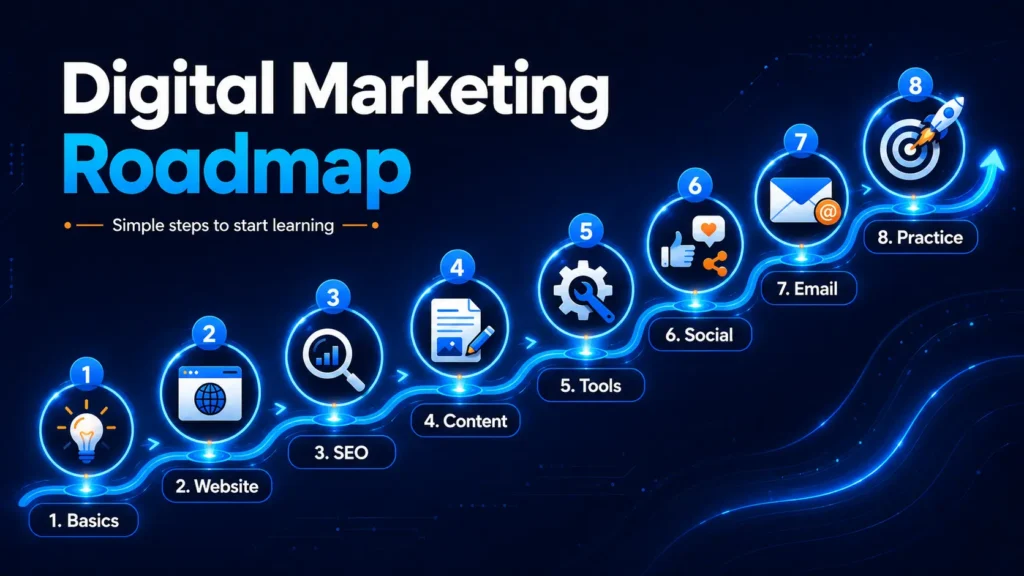
If you are a beginner, do not try to learn everything together. Follow a simple roadmap.
Step 1: Understand the basics
First learn what digital marketing is, how it works, and what the main types are.
Step 2: Learn website and WordPress basics
A website helps you practice digital marketing properly. Learn how pages, posts, menus, categories, and plugins work.
Step 3: Start learning SEO
SEO is important for long-term organic traffic. Begin with keyword research, helpful content, on-page SEO, and internal linking.
Step 4: Practice content writing
Write beginner-friendly articles. Focus on clarity, structure, examples, and solving one problem at a time.
Step 5: Use free SEO and marketing tools
Start with free SEO tools before buying paid tools, especially when you are still learning the basics. Learn Google Search Console, Google Analytics, Google Trends, Keyword Planner, and basic SEO plugins.
Beginners can also explore Google’s Digital Marketing & E-commerce Certificate to understand digital marketing topics in a structured way.
Step 6: Learn social media basics
Choose one or two platforms. Share useful tips, blog updates, and simple educational content.
Step 7: Understand email marketing
Learn how email lists work and why subscribers are important for long-term audience building.
Step 8: Learn paid ads later
Do not rush into ads. First understand audience, content, website, and conversion basics.
Step 9: Build small projects
Practice through your own blog, website, or sample project. Real practice teaches more than only watching videos.
Step 10: Improve step by step
Digital marketing changes with time. Keep improving your content, SEO, design, communication, and tools knowledge.
This roadmap keeps learning simple and practical.
Common Mistakes Beginners Should Avoid
Many beginners make mistakes because they try to do everything quickly.
The first mistake is thinking digital marketing is only about earning money. Earning can be a result, but the base is skill, practice, and trust.
The second mistake is learning too many topics at once. SEO, ads, social media, email, content, and analytics are all important, but you should learn step by step.
The third mistake is ignoring basics. Without understanding audience, content, and website structure, advanced tools will not help much.
The fourth mistake is copying others blindly. What works for one creator or business may not work for you. Your niche, audience, skill level, and resources may be different.
The fifth mistake is expecting quick results. Digital marketing takes testing and patience. Some results may come fast, but long-term growth usually takes time.
The sixth mistake is creating content only for search engines. Content should be useful for real people first. SEO should support the content, not damage the reader experience.
The seventh mistake is not tracking performance. If you do not check what is working, you cannot improve properly.
So, as a beginner, focus on the basics:
Learn clearly, practice regularly, track performance, and improve slowly.
Digital marketing becomes easier when you treat it like a skill-building journey, not a shortcut.
Once your basics become stronger, you can also understand how bloggers make money through ads, affiliate marketing, services, products, and email lists.
FAQs About Digital Marketing for Beginners
1. What is digital marketing in simple words?
Digital marketing means promoting a product, service, brand, website, or content using online platforms like Google, websites, social media, email, online ads, and videos. In simple words, when marketing happens through the internet, it is called digital marketing.
2. Is digital marketing good for beginners?
Yes, digital marketing is good for beginners because it can be learned step by step. You do not need to master everything in one day. Start with basics like SEO, content writing, WordPress, social media, and simple analytics. With regular practice, you can slowly build strong skills.
3. Do I need coding to learn digital marketing?
No, coding is not required to start learning digital marketing. Basic website knowledge is helpful, but you can begin with WordPress, SEO, content writing, social media, and free tools. Later, if you want, you can learn basic HTML or technical website concepts, but it is not compulsory in the beginning.
4. Which digital marketing skill should beginners learn first?
Beginners should first learn the basics of website, content writing, and SEO. These skills help you understand how online content works, how people find information on Google, and how websites attract visitors. After that, you can learn social media, email marketing, analytics, and paid ads.
5. Can I learn digital marketing for free?
Yes, you can start learning digital marketing for free using blogs, YouTube videos, free SEO tools, Google Search Console, Google Analytics, Google Trends, and practice projects. Free learning is enough in the beginning, but real improvement comes when you practice regularly.
6. How long does it take to learn digital marketing?
There is no fixed time. You can understand the basics in a few weeks, but becoming skilled takes regular practice. Digital marketing is a practical skill, so you improve by writing content, doing SEO, using tools, tracking performance, and working on real projects.
7. Can digital marketing help bloggers?
Yes, digital marketing is very helpful for bloggers. Blogging needs SEO, keyword research, content writing, social sharing, email list building, and audience trust. If a blogger understands digital marketing, they can grow their blog in a more planned and practical way.
Final Thoughts
Digital marketing for beginners may look big in the starting, but it becomes simple when you learn it step by step.
You do not need to master SEO, social media, email marketing, ads, analytics, and content writing all together. First understand the basics. Then practice one skill at a time.
Digital marketing is not a quick-money shortcut. It is a useful skill that helps bloggers, businesses, freelancers, creators, and website owners reach the right audience online.
Remember this simple formula:
Skill → Practice → Trust → Opportunity
Pehle basics strong karo, phir small projects par practice karo, aur slowly experience build karo.
If you are a beginner, start with simple guides on DigitalBhai and keep learning one step at a time.