
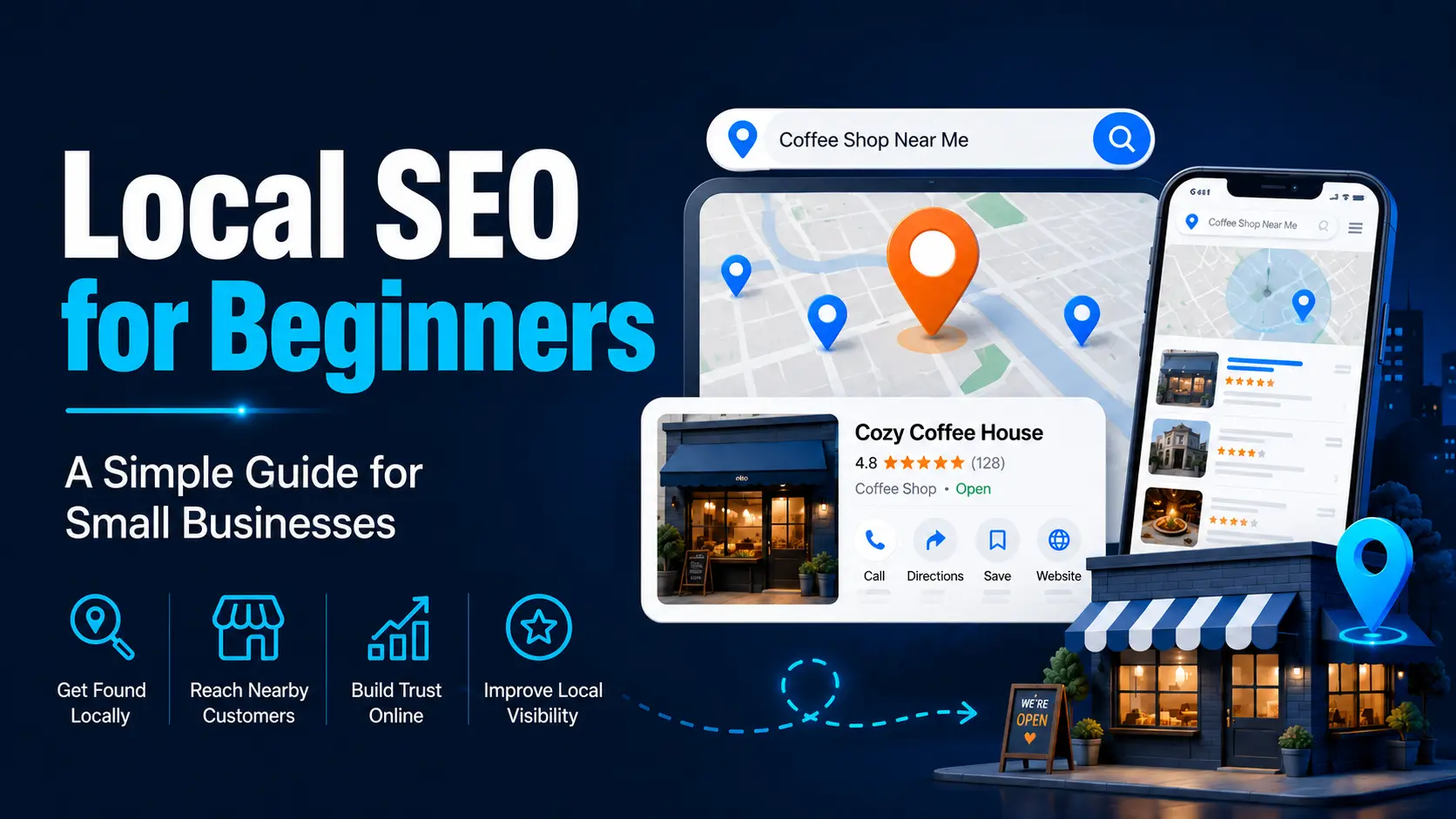
When someone searches for “dentist near me,” “AC repair in Patna,” or “bakery in Kankarbagh,” Google may show nearby businesses through Search and Maps. Local SEO helps a business improve its visibility for these location-based searches.
It can be useful for shops, clinics, restaurants, coaching centres, consultants, and service providers that meet customers at a business location or travel to serve them. Simple words mein, Local SEO nearby customers ko aapka business discover karne mein help karta hai.
However, Local SEO is not limited to creating a Google Business Profile. It also involves accurate business information, a useful website, relevant local keywords, genuine customer reviews, trusted local mentions, and regular updates.
The goal is not to promise the number-one position on Google. Instead, it is to make the business easier for nearby customers and search engines to understand and trust.
In this Local SEO for beginners guide, you will learn how local search works and the practical steps a small business can take to build stronger local visibility.
- What Is Local SEO for Beginners?
- Local SEO vs Traditional SEO
- How Google Local Results Work
- Check Google Business Profile Eligibility
- Complete Your Google Business Profile
- Keep Business Information Consistent
- Find and Use Local Keywords
- Optimize Your Website for Local Search
- Build Trust Through Genuine Reviews
- Local Citations, Links, and Updated Information
- Add LocalBusiness Schema Where Relevant
- Simple Local SEO Checklist
- Frequently Asked Questions
- Conclusion
What Is Local SEO for Beginners?
Local SEO is the process of improving a business’s visibility for searches connected to a particular city, area, or nearby location.
For example, a person may search for:
- Dentist near me
- Laptop repair in Patna
- Bakery in Kankarbagh
- Home tutor near Boring Road
Google may show regular website results along with a map and nearby business profiles. Local SEO helps an eligible business provide clear information so that search engines and potential customers can better understand what the business offers and where it operates.
Local SEO is not limited to Google Maps. It can also include the business website, location-based keywords, customer reviews, local mentions, accurate contact details, and useful service pages.
Before working on location-based optimization, it helps to understand the basic principles explained in this SEO guide for beginners.
Local SEO vs Traditional SEO
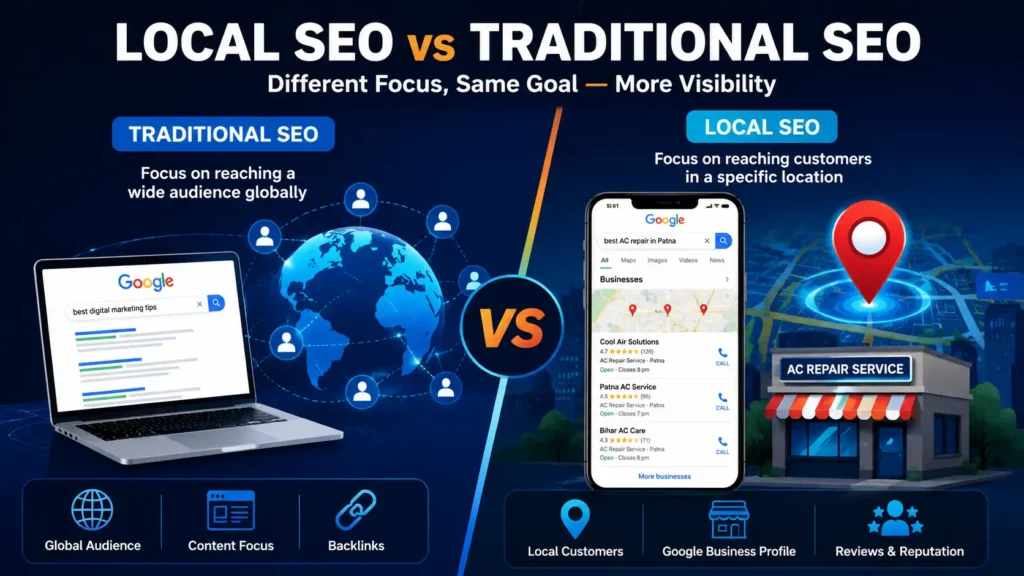
Traditional SEO usually focuses on reaching people through general searches, regardless of their location.
For example, a blog may target a keyword such as “how to start blogging” and attract readers from different cities or countries.
Local SEO has a narrower location-based focus. A salon, clinic, coaching centre, restaurant, or repair service may primarily want to reach customers in a particular area.
The main difference is that Local SEO also considers information such as:
- Business location or service area
- Google Business Profile
- Opening hours
- Phone number
- Customer reviews
- Local service pages
A business may use both approaches. Its website can rank for useful general information while its local pages and Business Profile help nearby customers find its services.
How Google Local Results Work
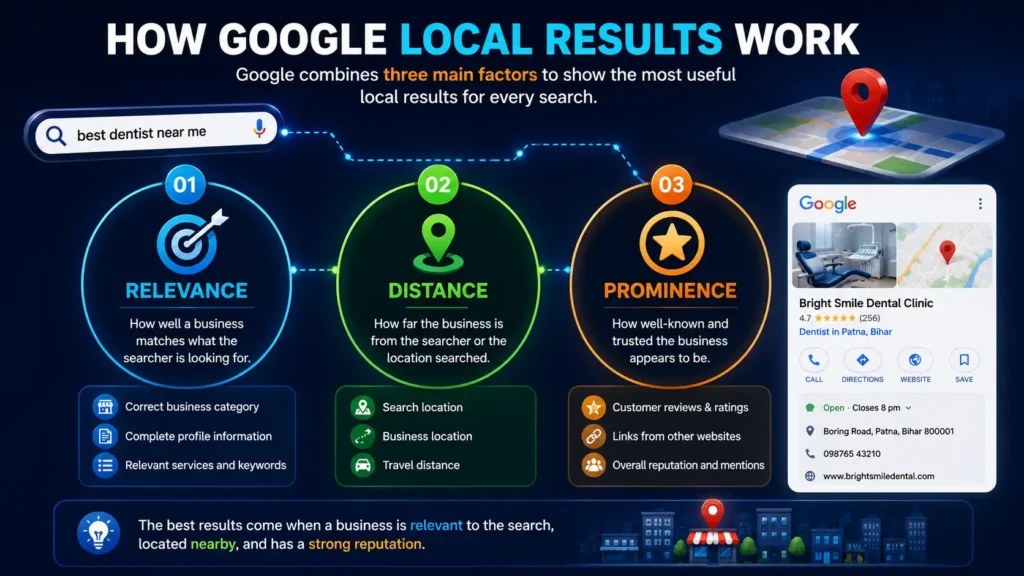
Google explains that local results are mainly based on relevance, distance, and prominence. A business cannot request or pay Google for a better organic local ranking.
Relevance
Relevance means how closely the business information matches what a person is searching for.
A complete Business Profile with the correct category, services, description, website, and contact information can help Google understand the business more clearly.
For example, a profile that accurately describes a laptop repair service is more relevant to that search than a profile containing unclear or incomplete details.
Distance
Distance refers to how far the business is from the person searching or from the location mentioned in the search.
A business cannot directly control where the customer is located. Therefore, Local SEO cannot guarantee visibility in every nearby city or area.
Prominence
Prominence refers to how well-known or established a business appears.
Google may consider information such as customer reviews, ratings, and links from other websites. A genuine local reputation usually develops gradually rather than through one quick optimization step.
Check Google Business Profile Eligibility
Before creating a Google Business Profile, first check whether the business is eligible.
Google generally requires a business to make in-person contact with customers during its stated working hours. Eligible examples may include:
- A shop or office that receives customers
- A clinic, salon, restaurant, or coaching centre
- A plumber, electrician, or repair service that visits customers
- A hybrid business that serves customers both at its location and at their location
Online-only brands, blogs, and businesses that never meet customers in person are generally not eligible for a Business Profile.
A service-area business may create a profile even without a customer-facing storefront when it travels to customers. However, a residential address should normally be hidden when customers are not served at that address. Fake addresses, virtual offices without genuine operations, and unnecessary duplicate profiles should be avoided.
Eligible businesses can add or claim a Google Business Profile at no charge.
Complete Your Google Business Profile
Creating a profile is only the first step. The information should be accurate, complete, and regularly reviewed.
Important details include:
- Real business name
- Primary business category
- Address or service area
- Phone number
- Website address
- Opening hours
- Business description
- Products or services
- Business photos
- Verification details
Use the same business name that customers see on the actual shop board, official documents, website, and other branding.
Do not add promotional words such as “best,” “number one,” or multiple service and city keywords unless they are genuinely part of the real business name.
For example, a business officially known as Amit Computer Care should not change its profile name to:
Amit Computer Care – Best Laptop Repair in Patna
Google’s guidelines require businesses to represent their real-world identity accurately. A profile should also use a real location, and generally only one profile should be created for each genuine business location.
Choose the category that most accurately represents the main service. Additional categories may be added only when they genuinely describe other important services.
Opening hours should also be updated during holidays, temporary closures, or major schedule changes. Incorrect hours can frustrate customers even when the profile appears in search results.
Keep Business Information Consistent
The term NAP commonly refers to:
Name, Address, and Phone Number
These important details should remain reasonably consistent across the Business Profile, website, contact page, and genuine business listings.
This does not mean every comma or abbreviation must always be identical. The main goal is to avoid confusing contradictions.
For example, customers may lose trust when:
- The website shows one phone number but the profile shows another
- The address is outdated on one platform
- The business name changes across different listings
- The working hours are no longer accurate
Whenever the business moves, changes its phone number, or updates its hours, review the main online profiles as well.
Find and Use Local Keywords
Local keywords combine a service, product, or business type with a location.
Examples include:
- Dentist in Patna
- AC repair in Kankarbagh
- Bakery near Boring Road
- Home tutor in Danapur
- Digital marketing consultant in Patna
Before selecting a keyword, think about what the customer actually wants.
You can follow this beginner-friendly keyword research guide to understand how to evaluate useful keywords instead of selecting them only by guesswork.
Someone searching for “how to repair an AC” wants information. A person searching for “AC repair near me” is more likely looking for a local service provider.
This difference becomes easier to understand when you learn the four types of search intent.
Local keywords can be used naturally in:
- Page titles
- Main headings
- Service-page content
- Meta descriptions
- Image alt text where relevant
- Contact and location information
Avoid repeating the city name in every sentence. Keyword stuffing can make the page difficult to read and may reduce trust.
The content should first explain the service clearly and then mention the location where it is genuinely useful.
Optimize Your Website for Local Search
A Google Business Profile does not replace a useful website. The website gives the business more space to explain its services, experience, process, location, and contact options.
The same page can also benefit from basic practices covered in this On-Page SEO guide.
A local business website should ideally include:
Clear Service Pages
Create useful pages for the main services instead of placing every service in one short paragraph.
For example, a computer repair business may have separate pages for:
- Laptop repair
- Desktop repair
- Data recovery
- Software installation
Each page should contain genuinely useful information rather than only a list of keywords.
Genuine Location Details
Mention the real business location or service area clearly. The contact page may include the address, phone number, working hours, directions, and a map when useful.
Do not create pages for cities where the business does not genuinely operate.
Mobile-Friendly Design
Many local searches happen when people need quick information such as directions, opening hours, or a phone number.
The website should therefore be easy to use on a mobile device. Buttons, forms, menus, and contact details should remain readable and clickable.
Useful Titles and Descriptions
A service page title can naturally combine the service and location.
For example:
Laptop Repair Services in Patna | Amit Computer Care
The page should still provide useful information. Merely adding a city name to a weak page is not enough.
Unique Location Pages
A business serving multiple genuine locations may create separate pages when each page offers unique value.
Each page should contain relevant information such as local service details, working process, directions, area-specific examples, or contact options.
Avoid publishing many almost-identical pages where only the city name changes.
Build Trust Through Genuine Reviews
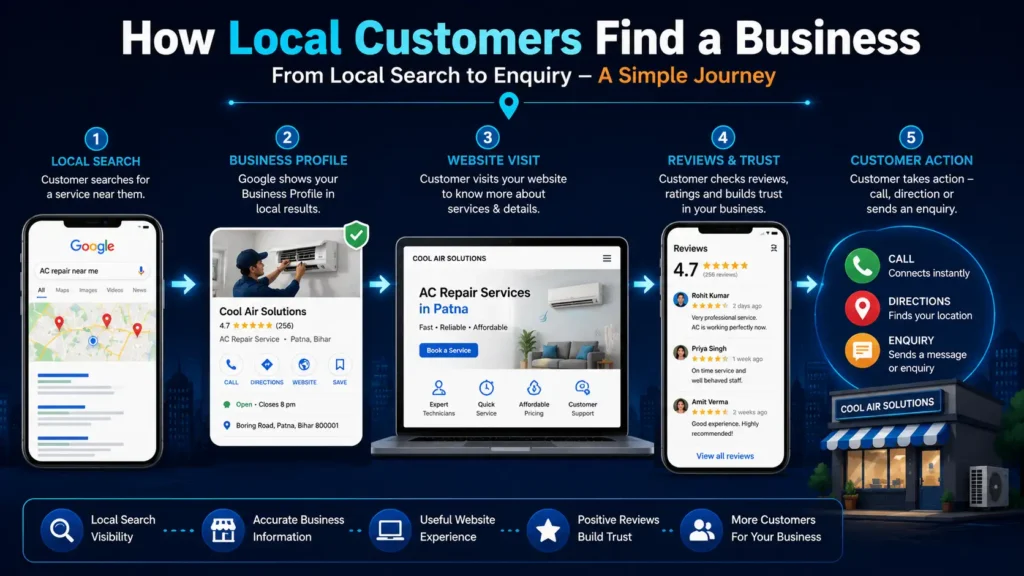
Customer reviews can help potential customers understand the real experience of using a business.
After completing a service, a business may politely ask the customer to share honest feedback. The request should not pressure the customer to leave only a positive review.
Never purchase fake reviews or ask people who have not used the service to post feedback.
Businesses should also respond professionally to reviews. A simple thank-you can acknowledge positive feedback, while a calm response to criticism can show that the business takes customer concerns seriously.
Google states that more reviews and positive ratings can support local ranking, but reviews should not be treated as a guaranteed ranking method.
Local Citations, Links, and Updated Information
A local citation is an online mention of important business details such as its name, address, and phone number.
These mentions may appear on:
- Relevant business directories
- Local association websites
- Industry platforms
- Local news websites
- Supplier or partner websites
Focus on genuine and relevant platforms instead of submitting the business to hundreds of unknown directories.
A local business may also earn useful links by participating in real community activities, joining relevant associations, publishing helpful local resources, or building genuine partnerships.
The Business Profile should also be kept fresh with accurate hours, current services, and clear photos. Updates should be made because they help customers—not because daily posting is believed to guarantee rankings.
Add LocalBusiness Schema Where Relevant
LocalBusiness schema is structured data that helps Google understand business information such as its name, address, opening hours, phone number, and business type.
WordPress users may add suitable schema through an SEO plugin such as Rank Math instead of writing technical code manually.
The schema information should match the details visible on the website. Do not add false ratings, an incorrect address, or services that the business does not offer.
Google explains that LocalBusiness structured data can provide business information in a standardized format, but it does not guarantee that a special search feature will appear.
Simple Local SEO Checklist
Before considering the basic Local SEO setup complete, check whether:
- The business is eligible for a Google Business Profile
- The profile has been added, claimed, and verified
- The real business name is used
- The correct primary category is selected
- Address or service-area information is accurate
- Phone number, website, and opening hours are updated
- Local keywords are used naturally
- Service and contact pages provide useful information
- Genuine customer reviews are managed professionally
- Important business details remain consistent
- The website works properly on mobile devices
- LocalBusiness schema is accurate where used
Local SEO is not a one-time task. Business information, customer needs, competitors, search behaviour, and Google features can change, so important details should be reviewed regularly.
Frequently Asked Questions
What is Local SEO in simple words?
Local SEO is the process of helping a business become easier to discover in searches connected to a particular city, area, or nearby location. It includes an accurate Google Business Profile, a useful website, relevant local keywords, genuine reviews, and consistent business information.
Is Google Business Profile free?
Yes. An eligible business can add or claim its Google Business Profile without paying Google. However, a consultant or agency may separately charge for setup, management, photography, SEO, or other professional services.
Can an online-only business create a Google Business Profile?
An online-only business that does not meet customers in person is generally not eligible for a Google Business Profile. Google usually requires a business to interact with customers face-to-face during its stated working hours, although some specific exceptions apply.
For example, an informational blog should not create a profile only to appear in Google Maps. A service-area business that travels to customers may be eligible when it follows Google’s requirements.
Do customer reviews help Local SEO?
Genuine customer reviews can support business trust and local prominence. Reviews may also help potential customers understand the quality of a business before contacting it.
However, reviews do not guarantee a particular ranking. Businesses should request honest feedback, avoid buying fake reviews, and respond professionally to both positive and negative comments. Google describes local results as mainly influenced by relevance, distance, and prominence.
How long does Local SEO take to show results?
There is no fixed time for Local SEO results. Progress may depend on the business location, competition, profile quality, website condition, reviews, local reputation, and the search being performed.
Some improvements may become visible after business information is verified and updated, while stronger local visibility may take longer to develop. Regular improvements are more realistic than expecting an immediate ranking change.
Conclusion
Local SEO is not limited to creating a Google Business Profile or adding a city name to a website.
It brings together an accurate business profile, useful service pages, relevant local keywords, consistent contact details, genuine customer reviews, local trust, and regular updates.
Shuruaat simple rakhein: first check whether the business is eligible for a Google Business Profile. Then review the business name, category, address or service area, phone number, website, and working hours.
Local SEO does not guarantee the top position, but a clear and trustworthy online presence can make it easier for nearby customers to understand and discover the business.
Start by checking your business information today. Correct one incomplete or outdated detail before moving to the next Local SEO step.