

Table of Contents
Digital marketing is a vital tool of the modern era that operates with the aid of the internet and digital devices—particularly mobile phones.
In this beginner’s guide, it helps place products or services before the widest possible audience, identifies specific target audiences, and presents offers tailored to them.
Conversely, consumers utilize this very digital platform to compare targeted products, select the best options for themselves, make purchases, and establish relationships with brands.
Why Digital Marketing
In the modern era, digital marketing has emerged as a crucial strategic necessity for anyone looking to expand their business; it is as competitive as it is accessible.
Indeed, beyond traditional strategies, digital marketing leverages data analytics to establish a global reach and allows businesses to prevent wasteful expenditure by focusing their efforts exclusively on their targeted audience.
Purpose of the beginner’s guide
The primary objective of this post is to provide beginners with a roadmap and explanation in extremely simple language.
In this beginner’s guide, anyone—even those with absolutely zero prior knowledge of digital marketing—can clearly understand what their next step should be after reading this content. The aim is to convey this information in the simplest possible terms.
Key concepts of Digital Marketing

Online presence
An online presence refers to the presence of an individual or a business on digital platforms via the internet.
Essentially, it encompasses how your brand appears—how attractive and appealing it is—on any platform across the internet, whether through a website, social media (such as Facebook or Instagram), or any other digital medium.
This presence may exist on a single platform or across multiple ones.
For instance, if someone searches for a hotel or any other entity, and that entity is discoverable via its website, Instagram profile, Google Reviews, or YouTube channel, this demonstrates its online presence.
Importance of digital marketing for businesses
In today’s era, the importance of digital marketing has grown immensely; one could even say that it has evolved from being merely an option into an absolute necessity for any business enterprise.
If your vision involves expanding your business, digital marketing has become an indispensable tool, as the majority of consumers now conduct extensive research and comparisons on the internet before making any purchase.
Its greatest strength lies in the fact that, through the medium of the internet, your reach extends to a global customer base—rather than being limited solely to a local level.
Furthermore, for the promotion of your brand, it proves to be far more cost-effective than expensive advertisements placed through traditional media channels; moreover, it enables you to establish direct contact with your specific buyers, thereby allowing for highly targeted marketing efforts.
Additionally, by utilizing various tools and analytics, you can accurately assess the effectiveness of the advertising campaigns you are running for your brand. Based on these insights, you can formulate your future strategies accordingly, ensuring the optimal utilization of your resources
The 7 Key Types of Digital Marketing: A Beginner’s Guide
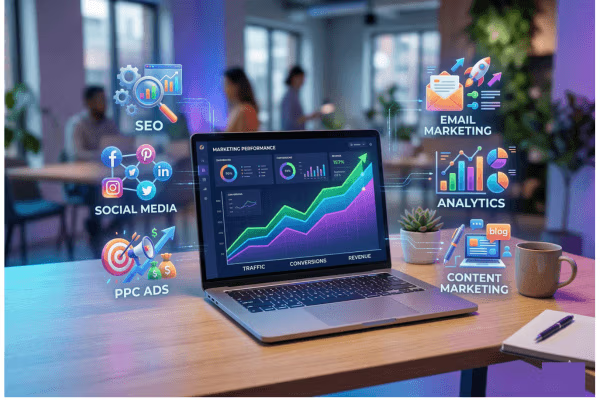
Digital marketing encompasses a variety of tools that can help you drive the growth of your business. Among these, the following core pillars are particularly instrumental in helping you expand your business.
SEO A Beginner’s Guide
Search Engine Optimization (SEO) is a process that enables a website to appear at the very top of search results—particularly on Google—thereby increasing its click-through rate.
In this beginner’s guide, you will understand how SEO works and why it is essential for online visibility.
The primary objective of this process is to structure a website’s content and layout in such a way that search engines can clearly understand the subject matter of the content.
To achieve this, the website requires clean headings, effective internal linking, and high-quality, substantive content. If organized properly, search engines are able to crawl and index the site much more efficiently.
Another significant benefit of SEO is that it generates organic (free) traffic, which proves highly advantageous for your business and helps you fully realize the value of having a website.
Content Marketing
Content marketing is a strategy that involves creating and sharing content specifically tailored to a particular audience.
In this beginner’s guide, It primarily entails publishing valuable and engaging content in formats such as blogs, videos, guides, and short-form clips.
The primary objective is not merely to advertise to the audience, but rather to inform them, assist them, and validate their curiosity—and it is precisely this approach that attracts an audience.
When value is delivered in a professional manner, it effectively promotes your brand and, over time, fosters trust.
Social Media Marketing
Social media marketing is the activity of promoting a product, service, or brand by creating and publishing content—crafted to be highly engaging, informative, and helpful—on social media platforms such as Facebook, Instagram, YouTube, and LinkedIn.
Its objective is to target specific audiences by keeping in mind particular demographics, communities, age groups, and tastes.
This approach boosts the demand for the product or brand and fosters connections among people, thereby significantly increasing the potential for the ultimate growth of the business.
Pay-Per-Click (PPC)
PPC is, in essence, a specific type of strategy wherein a business pays to display its advertisements on a search engine or a website.
Its primary objective is to establish a reach to potential customers through paid advertisements on platforms like Google or other relevant websites.
The most significant feature of this approach is that the advertiser is required to pay only when a user actually clicks on their advertisement.
Typically, PPC ads can targeted with specific demographics—such as a particular class, community, age group, gender, or interests—in mind.
This targeted approach makes the advertisements more effective and engaging, helping to drive immediate traffic to the business’s website and thereby increasing the likelihood of generating leads. Consequently, the result is that businesses only incur the expenditure that is strictly necessary.
Email Marketing

Email Marketing is a digital marketing strategy that involves sending messages to a group of subscribers through email. It mainly focuses on sending personalized messages to a subscriber list based on their interests or behavior.
Businesses use email to share newsletters, promotions, updates, and useful content. Personalization helps make the message more relevant and engaging for the reader.
Email marketing also helps businesses stay connected with their customers regularly. It is a cost-effective way to communicate directly with the audience.
One of the biggest benefits is its high ROI (Return on Investment) compared to many other marketing methods. It is also excellent for customer retention because it keeps existing customers engaged with the brand.
Affiliate Marketing
The term “Affiliate” signifies “to associate with someone”—specifically, to market the products of a business or brand, with the primary objective of converting those efforts into actual sales.
In this strategy, an individual generates sales by leveraging their own resources and network; in return, they receive a fixed commission from the business.
This operates largely in the same manner as the traditional commission-based agency model, but with the distinct advantage that the entire process is executed through digital platforms.
Influencer Marketing
Influencer marketing is akin to celebrity endorsements—much like when a film star, a cricket icon, or any other public figure recognized for their specific achievements collaborates with a brand to boost sales.
Similarly, the landscape of social media today is populated by numerous individuals who possess substantial followings and exert significant influence over their followers.
When such an individual promotes a product, it can lead to a surge in sales; consequently, businesses hire these influencers and compensate them with a fixed commission.
Conclusion
In short, in the modern era, no business can effectively manage itself without digital marketing. It has become an indispensable tool for reaching a vast audience.
By establishing a strong online presence—leveraging strategies such as content marketing, SEO, PPC, social media marketing, and email marketing—businesses can significantly boost their sales.
Today, it is imperative that businesses recognize this reality and align themselves with these strategies to drive their growth forward. It could say that, with the help of digital marketing:
Reach and engagement are enhanced;
It offers cost-effectiveness compared to traditional marketing; and
It enables data-driven decision-making.