
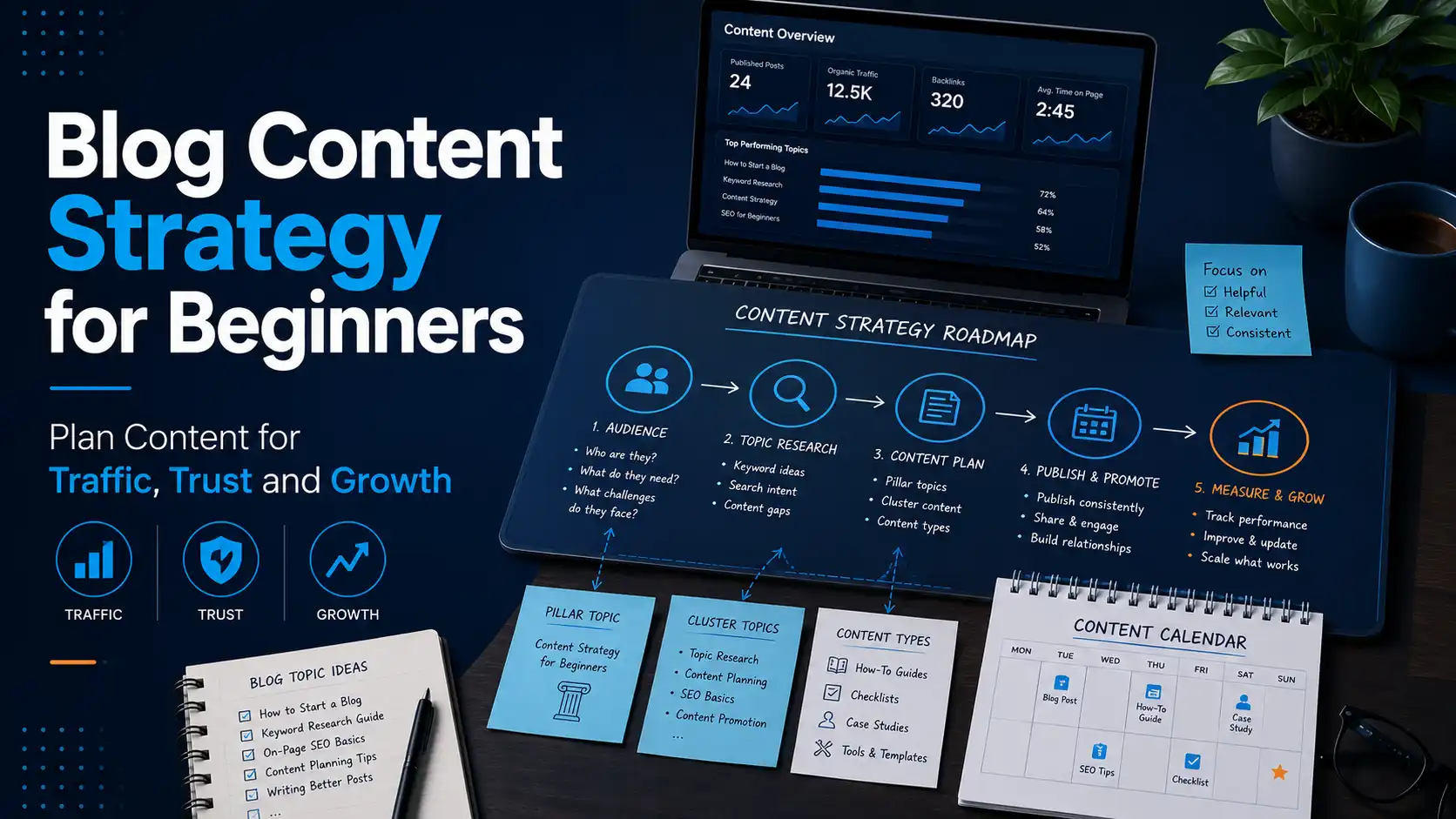
Starting a blog is one thing, but deciding what to publish every week can quickly become confusing.
A clear blog content strategy helps you decide what to publish, who the content is for and how each post supports your long-term goals.
Many beginners collect random topic ideas, write whatever feels interesting at the moment and later wonder why their posts do not connect with each other or support a clear goal. Some focus only on search traffic, while others publish earning-related content before building enough trust.
A blog content strategy for beginners helps solve this problem. It gives you a practical system for deciding who you want to help, which topics you should cover, what purpose each post will serve and in what order the content should be published.
A useful content strategy is more than a list of blog titles or a monthly calendar. It connects your audience, blog goals, content pillars, search opportunities, publishing capacity and future earning plans.
In this guide, you will learn how to create content pillars, balance traffic-building and trust-building posts, prioritize topic ideas and build a realistic publishing plan. सरल शब्दों में, हम random blogging को एक clear and manageable content system में बदलेंगे।
- What Is a Blog Content Strategy?
- Why Do Beginners Need a Content Strategy?
- Step 1: Define Your Target Audience
- Step 2: Set a Clear Blog Goal
- Step 3: Choose Your Content Pillars
- Step 4: Create the Right Content Mix
- Step 5: Find and Organize Topic Ideas
- Step 6: Prioritize Topics Before Writing
- Step 7: Build a Realistic Publishing Schedule
- Step 8: Plan Content Clusters and Internal Links
- Step 9: Create a 90-Day Beginner Content Plan
- Step 10: Track Results and Review the Strategy
- Common Blog Content Strategy Mistakes
- Practical Blog Content Strategy Checklist
- Frequently Asked Questions About Blog Content Strategy
- Conclusion
- Build Your First Blog Content Plan
What Is a Blog Content Strategy?
A blog content strategy is a clear plan that explains what you will publish, who the content is for, why each post is being created and how different posts will support your larger blogging goals.
It is not simply a list of article titles.
A proper strategy connects:
- Your target audience
- Blog goals
- Content pillars
- Search opportunities
- Publishing capacity
- Internal links
- Trust-building
- Future earning opportunities
- Performance tracking
For example, suppose you run a beginner-focused blogging website. Randomly publishing one SEO post, one motivation post and one unrelated technology article may make the website confusing.
A content strategy helps you decide that your main areas will be blogging, WordPress and SEO. It also helps you plan which beginner questions should be answered first and how one article will lead naturally to another.
Simply put, a blog content strategy answers four questions:
- Who are you helping?
- What will you publish?
- Why are you publishing it?
- How will you know whether it is working?
Why Do Beginners Need a Content Strategy?
Many new bloggers start with enthusiasm but struggle after publishing their first few posts.
If you are still preparing your website, this guide to starting a blog explains the basic steps that come before building a long-term content plan.
They may have several ideas, but they do not know which topic should come first. As a result, they either publish random content or spend too much time searching for the “perfect” keyword.
A content strategy gives direction to this effort.
It Prevents Random Publishing
Every useful idea does not need to be published immediately.
Some topics may be relevant to your audience but not connected to your current website stage. Other topics may require supporting articles before they can perform well.
A strategy helps you arrange ideas in a logical order instead of selecting topics only according to mood.
It Creates a Better Reader Journey
A visitor may first read a basic article, then move to a practical guide and later explore a tool, service or advanced resource.
For example:
- What is blogging?
- How to choose a blogging niche
- How to start a blog
- How to plan blog content
- How bloggers make money
These posts create a natural learning journey.
Without planning, the reader may find one useful post but have no clear next step.
It Helps You Use Limited Time Better
Most beginners do not have a large writing team. They may be managing a job, family responsibilities and a blog at the same time.
A content strategy helps you use limited hours on topics that have a clear purpose.
Iska simple matlab hai: har post likhne se pahle yeh clear hona chahiye ki woh post audience aur website ko kis tarah support karega.
It Connects Content With Long-Term Goals
Some posts can attract new visitors. Some can build trust. Some can support affiliate opportunities, services, downloads or email subscribers.
A balanced content strategy ensures that the website does not become only an information library or only a promotional platform.
Step 1: Define Your Target Audience
Before planning blog topics, understand who you want to help.
A clear audience is also closely connected to selecting a suitable blogging niche, because your niche defines the main problems and subjects your blog will cover.
A broad audience description such as “people interested in digital marketing” may not provide enough direction.
A clearer description would be:
Beginners who want to learn blogging, WordPress and SEO in simple language while building a website with limited time and budget.
This description helps you understand:
- The reader’s current knowledge level
- The problems they are facing
- The language they understand
- The tools they may use
- Their budget and limitations
- What they want to achieve
Questions to Understand Your Audience
Ask:
- Is the reader a complete beginner or an informed beginner?
- What problem is stopping them?
- What have they already tried?
- Are they looking for information, comparison or action?
- What words would they use while searching?
- What result do they expect after reading the article?
You do not need complex audience-research software in the beginning.
You can learn from:
- Google search suggestions
- People Also Ask questions
- Blog comments
- Community discussions
- Emails and contact-form questions
- Search Console queries
- Your own beginner experience
Your understanding of the audience will improve as more people visit and interact with the website.
Step 2: Set a Clear Blog Goal
Your content plan should support a clear goal.
A new blog may have several long-term goals, but it is better to choose one or two current priorities.
Common blogging goals include:
- Building organic traffic
- Creating audience trust
- Growing brand recognition
- Collecting email subscribers
- Generating service enquiries
- Supporting affiliate income
- Selling a useful digital product
- Building a professional portfolio
For a new blog, the immediate goal may be:
Publish a useful foundation of connected content and start receiving relevant search impressions and visitors.
The future goal may be monetization, but early content usually needs to build visibility and trust first.
Separate Current and Future Goals
Your current goal might be to publish ten strong beginner guides.
Your future goal might be to generate affiliate income, service leads or passive income.
Both goals are important, but they require different actions.
A clear strategy helps you work on today’s foundation without forgetting tomorrow’s earning direction.
Step 3: Choose Your Content Pillars
Content pillars are the main subjects around which your blog will consistently publish content.
For example, a beginner digital-learning blog may choose:
- Blogging
- WordPress
- SEO
- Digital marketing
Each pillar can contain several related topics.
Blogging Pillar
Possible topics:
- How to start blogging
- Choosing a niche
- Blog content strategy
- Blogging mistakes
- Blog monetization
WordPress Pillar
Possible topics:
- WordPress setup
- Themes and plugins
- Website speed
- Post formatting
- WordPress SEO settings
SEO Pillar
Possible topics:
- SEO basics
- Keyword research
- Search intent
- On-page SEO
- Technical SEO
- Off-page SEO
Content pillars help readers and search engines understand what your website mainly covers.
Do Not Create Too Many Pillars
A new blogger may feel tempted to cover every interesting topic.
However, six or seven unrelated pillars can create:
- Weak topical focus
- Too many empty categories
- Difficulty maintaining consistency
- Confusing navigation
- Limited depth in each subject
Begin with two to four strong pillars. Add another pillar only when you have enough knowledge, time and topic ideas to support it properly.
Step 4: Create the Right Content Mix
Every post does not have to serve the same purpose.
A practical blog content strategy can use four types of content.
Traffic-Building Content
These posts answer questions people may search for.
Examples:
- What is search intent?
- How to start a blog
- WordPress setup for beginners
- Common SEO mistakes
Their main role is to attract relevant visitors and introduce them to your website.
Trust-Building Content
These posts help readers understand your approach, experience and values.
Examples:
- Lessons learned while building a blog
- Honest beginner mistakes
- A practical website-improvement journey
- Detailed explanations without unrealistic promises
Trust-building content may not always have high search volume, but it can strengthen the relationship with readers.
Earning-Connected Content
These posts are connected to products, tools, services or decisions.
Examples:
- Best tools for a specific blogging task
- Free vs paid SEO tools
- Hosting comparisons
- Honest product reviews
- Ways bloggers can monetize useful content
The article should first help the reader make a better decision. A commission or earning opportunity should never become the only reason for recommending something.
Beginners can also study the different ways bloggers make money to understand which income methods may fit their audience and website stage.
Conversion and Support Content
These pages help an interested visitor take the next step.
Examples:
- Contact page
- Service page
- Email signup page
- Download page
- About page
- Product page
These may not be regular blog posts, but they are part of the complete content system.
A Simple Beginner Content Mix
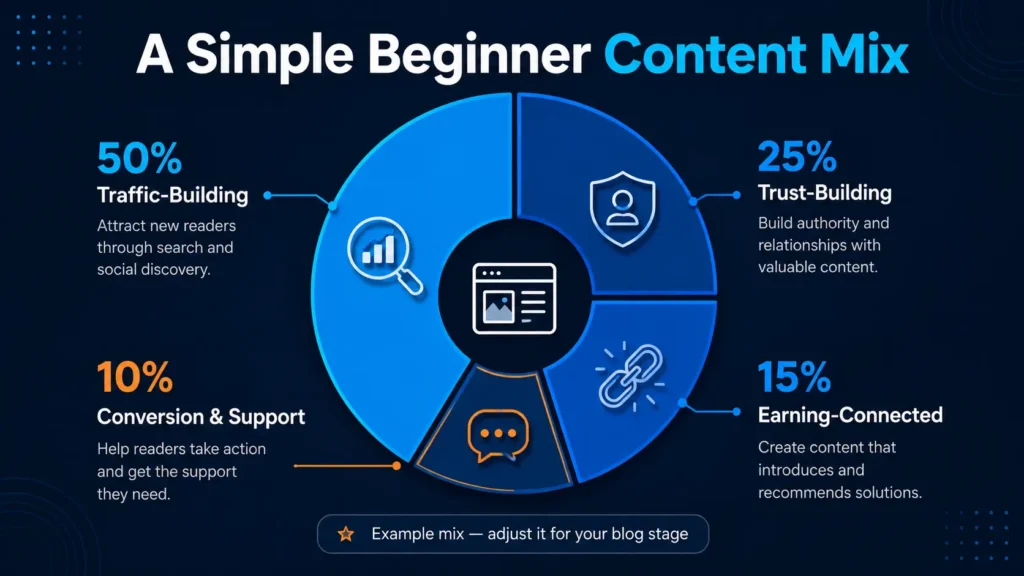
There is no fixed ratio for every website, but a beginner can start with an approximate mix such as:
- 50% traffic-building content
- 25% trust-building content
- 15% earning-connected content
- 10% conversion or support content
This is only a planning example. The correct balance depends on your blog stage, audience and business model.
Step 5: Find and Organize Topic Ideas
Topic ideas can come from many places, but they should be stored in one organised system.
Possible sources include:
- Keyword research
- Search intent analysis
- Google suggestions
- Competitor content gaps
- Reader questions
- Search Console queries
- Comments and online communities
- Problems you have personally solved
- Existing posts that need supporting content
Avoid keeping ideas only in your memory.
Use a spreadsheet, notebook, project-management tool or simple document.
For every idea, record:
- Proposed title
- Main keyword
- Target reader
- Search intent
- Content pillar
- Content purpose
- Priority
- Possible internal links
- Earning connection
- Current status
This makes topic selection easier when it is time to write.
A practical keyword research guide for beginners can help you discover relevant search questions instead of choosing every topic only from personal assumptions.
Step 6: Prioritize Topics Before Writing
A long list of ideas is not yet a strategy.
You need a simple method to decide which topic should be published first.
Evaluate every topic using these criteria:
Audience Relevance
Does the topic solve an important problem for your target reader?
Search Opportunity
Are people likely to search for this question or topic?
You should also understand the search intent behind the keyword so that the planned content format matches what the reader expects.
You do not always need a high-volume keyword. A specific low-volume query can still bring relevant visitors.
Existing Content Connection
Can the new post support or link naturally with content already published on your website?
Practical Ability
Can you explain the topic clearly and accurately?
Do you have enough understanding, experience or reliable research to create useful content?
Earning Connection
Can the topic support a future affiliate opportunity, service, lead, product or subscriber journey?
A topic does not need a direct earning angle to be valuable. However, the complete content plan should include some topics that can support monetization.
Simple Topic-Priority Score
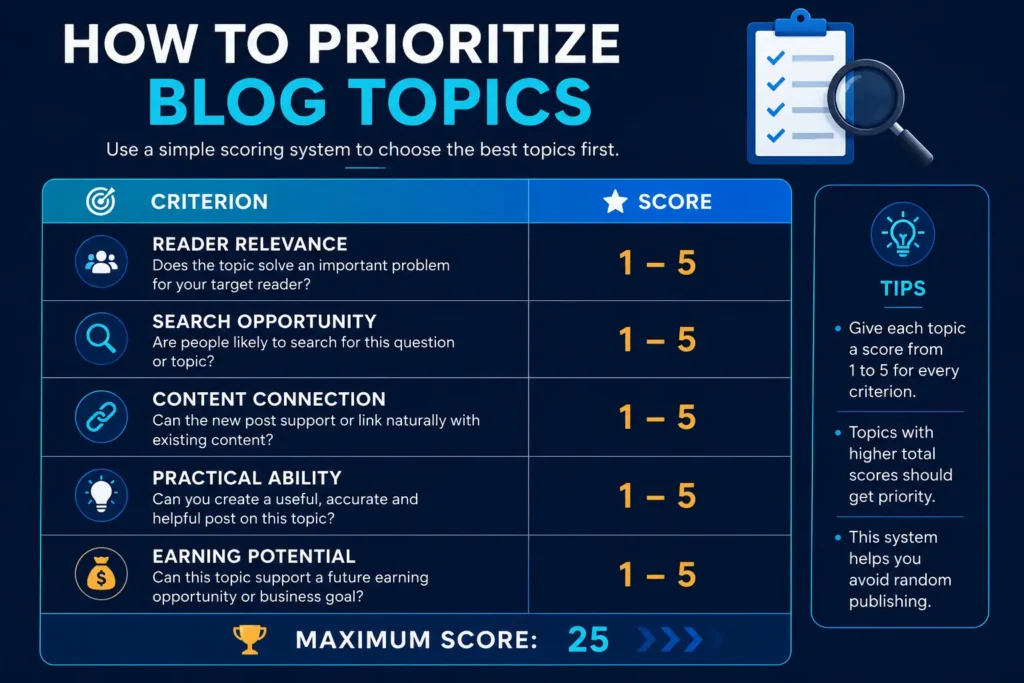
Give each topic a score from 1 to 5 for:
- Reader relevance
- Search opportunity
- Existing-content connection
- Ability to create useful content
- Future earning connection
The maximum score will be 25.
A topic scoring 21 may deserve priority over one scoring 13.
This scoring system is not a guarantee of traffic. It is simply a practical way to reduce random decisions.
Step 7: Build a Realistic Publishing Schedule
The best schedule is not the most aggressive schedule. It is the schedule you can maintain without reducing content quality.
A person working full-time may not be able to publish three detailed posts every week.
Calculate Your Real Capacity
Estimate:
- How many hours you can give each month
- How long research takes
- How long writing takes
- Time needed for editing
- Image creation
- WordPress formatting
- SEO setup
- Final checking
For example, if you can give approximately 20 hours per month and one complete post requires 8 to 10 hours, then two strong posts per month may be realistic.
Publishing fewer useful posts consistently is better than publishing quickly and stopping after one month.
Create a Repeatable Workflow
A basic workflow may be:
- Topic validation
- Keyword and intent check
- Outline
- Draft
- Editing
- Images
- Internal links
- SEO settings
- Publish
- Indexing and tracking
A repeatable workflow saves decision-making time and improves quality.
Step 8: Plan Content Clusters and Internal Links
A content cluster is a group of related posts connected around a main topic.
For example:
Main Topic: SEO Basics
Supporting posts may include:
- Keyword research
- Search intent
- On-page SEO
- Technical SEO
- Off-page SEO
- Internal linking
- SEO tools
These posts should link to each other where the connection is genuinely useful.
Plan Links Before Publishing
Before writing a new post, ask:
- Which existing article can explain a related concept?
- Which older post should link to this new article?
- What should the reader explore next?
- Is there a main pillar page that this article supports?
Internal linking should not be added only to increase link count.
Each link should help the reader move to relevant information.
Step 9: Create a 90-Day Beginner Content Plan
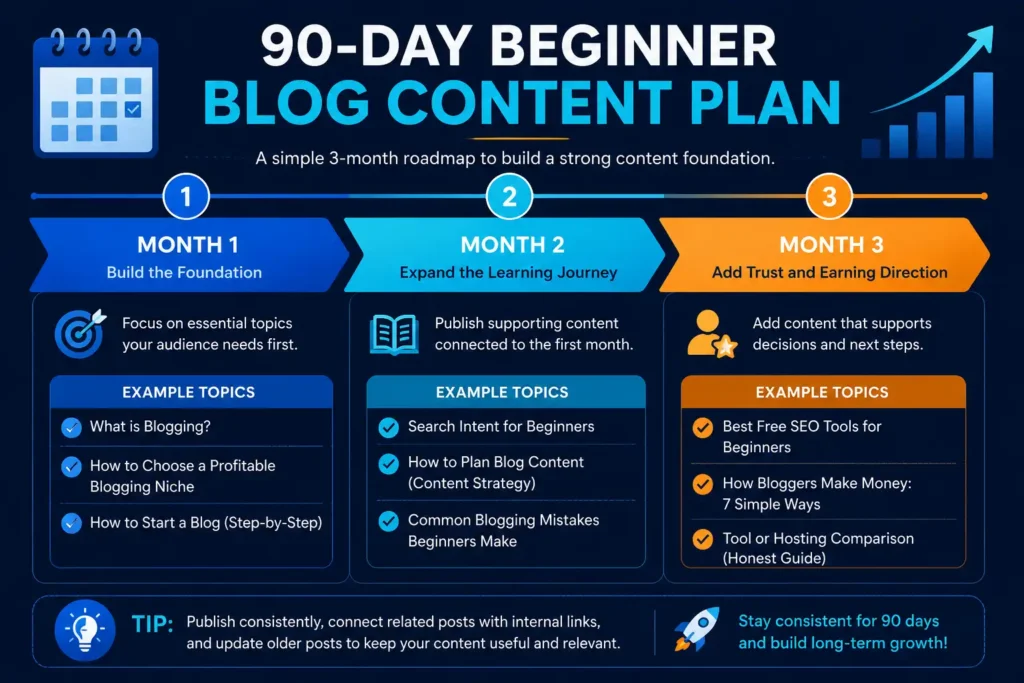
A 90-day plan gives enough direction without trying to predict the entire year.
Your plan can be divided into three stages.
Month 1: Build the Foundation
Focus on essential topics your audience needs first.
Example:
- Beginner foundation guide
- Important setup tutorial
- Basic problem-solving article
Month 2: Expand the Learning Journey
Publish supporting content connected to the first month.
Example:
- Search intent guide
- Content planning guide
- Common mistakes post
Month 3: Add Trust and Earning Direction
Include content that supports decisions or next steps.
Example:
- Honest tool comparison
- Practical experience-based post
- Monetization-related beginner guide
A solo blogger publishing two posts per month may create six posts in 90 days. Someone with more time may publish eight to twelve.
The number is less important than relevance, consistency and connection.
Step 10: Track Results and Review the Strategy
A content strategy should not remain unchanged forever.
Review results regularly and learn what is working.
You can use Google Search Console to review search queries, impressions, clicks and the pages appearing in Google Search.
Useful signals include:
- Search impressions
- Organic clicks
- Average search position
- Click-through rate
- Pages receiving traffic
- Queries showing your content
- Internal-link clicks
- Email signups
- Contact enquiries
- Affiliate clicks or sales
- Returning visitors
A new blog may not have enough data every week. A monthly review is usually more practical.
Ask These Questions During the Review
- Which posts are getting impressions?
- Which topics are attracting relevant visitors?
- Are readers moving to related posts?
- Which content pillars are still weak?
- Are earning-connected posts useful or overly promotional?
- Which posts need updates?
- Which topic should be published next?
Do not rewrite a post every time it receives a few impressions without clicks. Small websites need time and more content before useful patterns become clear.
Common Blog Content Strategy Mistakes
Publishing Only High-Volume Keywords
High search volume often comes with strong competition.
Beginners should also target specific, relevant questions where they can provide a clear answer.
Creating Too Many Categories
A category with only one post does not create meaningful content depth.
Choose fewer categories and build them properly.
Writing Only Traffic Content
Traffic is important, but a website also needs trust, helpful next steps and future monetization paths.
Publishing Only Earning-Related Posts
If every post promotes tools or products, readers may not develop enough trust.
Value should come before promotion.
Copying a Competitor’s Content Calendar
Another website may have a different audience, authority, budget and business model.
Study competitors for ideas, but build a strategy according to your own audience and capacity.
Ignoring Old Content
A content strategy should include updates, internal linking and improvement of existing posts.
Old content can continue supporting the website when it remains accurate and useful.
Setting an Unrealistic Schedule
An aggressive calendar can lead to rushed content, exhaustion and inconsistency.
Choose a schedule that you can maintain for several months.
Practical Blog Content Strategy Checklist
Before finalising your strategy, confirm:
- I know who my primary reader is.
- My blog has a clear current goal.
- I have selected two to four content pillars.
- My topic ideas are organised in one place.
- Every planned post has a purpose.
- I have a balance of traffic, trust and earning-connected content.
- I have prioritised topics instead of choosing randomly.
- My publishing schedule matches my available time.
- Related posts are planned as content clusters.
- Internal links are considered before publishing.
- I have created a basic 90-day plan.
- I will review performance at least once a month.
- I will change the strategy based on meaningful data, not impatience.
A useful blog content strategy does not need to be complicated. It needs to be clear, realistic and connected to the needs of your audience.
Frequently Asked Questions About Blog Content Strategy
What is a blog content strategy?
A blog content strategy is a practical plan that explains who your content is for, which topics you will cover, why each post will be created and how the content will support your traffic, trust and earning goals.
It includes more than a list of titles. It also considers content pillars, topic priorities, publishing capacity, internal links and performance tracking.
What is the difference between a content strategy and a content calendar?
A content strategy explains the purpose and direction of your content.
It answers questions such as:
- Who is the target reader?
- Which content pillars will the blog cover?
- What purpose will each post serve?
- How will the content support the blog’s goals?
A content calendar focuses mainly on execution. It shows which post will be written or published on a particular date.
The strategy decides what and why to publish, while the calendar helps you manage when to publish it.
How many content pillars should a beginner blog have?
Most beginner blogs can start with two to four closely related content pillars.
Having fewer strong pillars makes it easier to build useful depth, organise categories and connect related posts. More pillars can be added later when you have enough time, knowledge and topic ideas to support them properly.
Does every blog post need to target a keyword?
No. Search-focused posts usually benefit from a relevant keyword, but every useful post does not need to target a high-volume search term.
Some posts may be created to:
- Build trust
- Share practical experience
- Answer an audience question
- Support an existing article
- Explain your approach
- Help visitors take the next step
The complete content strategy should include both search-based and audience-focused content.
How often should a beginner publish blog posts?
There is no single publishing frequency that works for everyone.
A realistic schedule depends on:
- Available time
- Research requirements
- Writing speed
- Editing
- Image creation
- WordPress formatting
- Final SEO checks
For a person managing a full-time job, publishing two strong posts per month may be more sustainable than trying to publish several rushed articles every week.
Consistency matters, but useful content and a manageable workflow matter more than an aggressive schedule.
When should a blog content strategy be reviewed?
A monthly review is practical for most new blogs.
However, a complete strategy does not need to be changed every month. First study meaningful patterns such as:
- Which posts are receiving impressions and clicks
- Which topics attract relevant visitors
- Which content pillars need more depth
- Which posts require updates
- Whether readers are moving to related content
- Whether earning-connected content remains useful and balanced
Major decisions should be based on enough data, not a few early impressions.
Conclusion
A successful blog does not grow only by publishing more articles. The posts need a clear purpose, logical order and connection with the needs of the target audience.
A practical blog content strategy helps you decide who you want to help, which content pillars you should develop, what type of posts you need and how often you can publish without reducing quality.
Traffic-building posts can bring new visitors. Trust-building content can strengthen the relationship with readers. Earning-connected content can create responsible monetization opportunities, while support pages can help interested visitors take the next step.
You do not need a complicated yearly plan when you are starting. Begin with a clear audience, two to four content pillars, an organised topic list and a realistic 90-day publishing plan.
Review the results regularly, learn from meaningful data and improve the strategy as your website, skills and audience grow.
The goal is not to create a perfect plan before taking action. The goal is to replace random publishing with a clear and manageable system.
Build Your First Blog Content Plan
Start by selecting your main content pillars and listing the most important problems your audience needs help solving.
Then organise your ideas according to reader relevance, search opportunity, existing-content connection and future earning potential.
Your first plan does not need to be perfect. It only needs to give your next few posts a clear direction and purpose.